Geyser vs Bedrock Dedicated Server: Which for Console Players?
Geyser vs Bedrock Dedicated Server: run Geyser on Paper for Java players and plugins, or BDS for a pure-Bedrock crowd. Which to pick and who joins each.
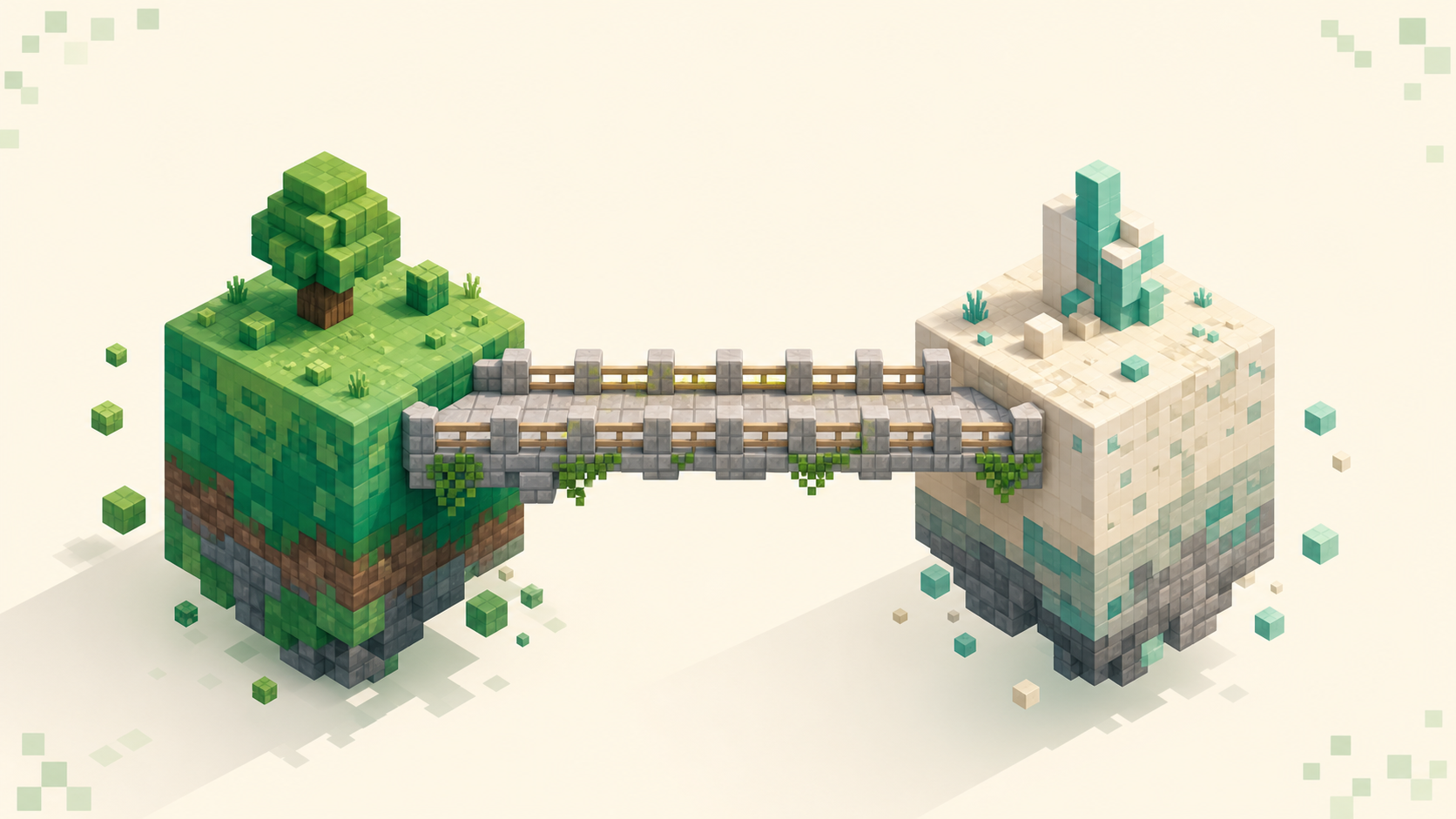
Pick Geyser if your server needs Java players or Bukkit-style plugins, and pick Bedrock Dedicated Server if your whole crowd is already on Bedrock. Geyser is a translator you bolt onto a Java server, usually Paper, so Bedrock consoles and phones can join a Java world, while Bedrock Dedicated Server (BDS) is Mojang's own native Bedrock server that only Bedrock clients ever connect to, trading the entire Java plugin ecosystem for a simpler setup and native Bedrock feel.
These are two different server programs, not two settings of the same thing, and most of the confusion around "should I run both?" comes from treating them as interchangeable. They aren't.
The one question that decides it
Do you also need Java players and Java plugins? That's the whole fork.
If the answer is yes, meaning you have Java regulars or you want the plugin toolbox, Geyser wins, because BDS cannot admit a single Java client. Not one, not ever. If your audience is entirely on Bedrock (Xbox, PlayStation, Switch, mobile, Windows 10/11), then BDS wins on simplicity and native feel, and running a full Java stack underneath it just to reach people who are already Bedrock is wasted effort.
One more thing worth nailing down before you plan anything: Geyser only runs one direction. It brings Bedrock players onto a Java server. There is no reverse bridge that puts Java players onto a BDS. So if you were hoping to stand up a Bedrock server and let your Java friends in through some plugin, that path doesn't exist.
What each one actually is
Geyser is GeyserMC's open-source proxy. It pretends to be a Java client and translates packets both ways, so a Bedrock console talks to it in Bedrock and it relays that to your Java server as Java. It runs on a Bukkit-family server (Paper is the standard base) and it usually rides alongside Floodgate, the companion that removes the linked-Java-account requirement, so Bedrock players don't each need an authenticated Microsoft or Java account to join. If you want the full picture of the two pieces, what Geyser and Floodgate are covers it. On this setup, Bedrock listens on 19132/UDP and Java listens on 25565/TCP, two separate doors on the same machine.
BDS is Mojang's official free Bedrock Dedicated Server. You download it for Windows or Ubuntu Linux only. There's no official macOS build, so Mac owners run it inside Docker or a Linux VM. It runs a native Bedrock world, and its config lives in server.properties with keys you'll recognize: server-port=19132 (IPv4 UDP), server-portv6=19133 (IPv6), plus level-name, max-players, online-mode=true, and allow-list=true. The allow list is managed through allowlist.json or the in-console /allowlist add command.
Who can actually join each
The join rules are the hard split between these two, and they're where people get their plans wrong, so here they are plainly.
Geyser on Paper: Java players connect natively on 25565, Bedrock players get bridged in on 19132, and everyone shares one world. The catch is that anything needing a client-side Java mod (custom blocks, custom items, a big content modpack) is unsupportable through Geyser, because the Bedrock client has no way to render assets it was never shipped. So heavily modded packs stay Java-only anyway.
BDS: Bedrock clients only, forever, no exceptions. There is no flag, no add-on, and no proxy that lets a Java client onto a BDS. If even one regular in your group is a Java player who won't switch editions, BDS is off the table for you — pick Geyser and move on. This is the same edition split players run into from the other side; crossplay vs Java-only servers for console frames it from the player's seat.
Plugins vs add-ons: the feature gap
This is why feature-rich communities almost always land on Geyser.
A Java server hands you the whole Bukkit/Spigot/Paper plugin ecosystem. LuckPerms for ranks and permissions, WorldGuard for region protection, Essentials for the standard command set, economy plugins for player trading, and real server-side anti-cheat like Grim or Vulcan that actually inspects movement and combat packets. (Paper vs Spigot vs Fabric covers the software base those plugins run on.) You drop a jar in the plugins folder and restart, and that's the whole install for most of them.
BDS has no Bukkit or Spigot plugin support at all. Its only sanctioned extension model is add-ons: behavior packs and resource packs that live in the behavior_packs and resource_packs folders and get activated per-world through world_behavior_packs.json, plus the @minecraft/server scripting API for JavaScript logic. Add-ons are genuinely powerful for gameplay tweaks (custom mobs, custom items, scripted events), but they're nowhere near the off-the-shelf depth of the plugin catalog. There's no drop-in equivalent to LuckPerms or WorldGuard; you'd be scripting that behavior yourself.
Gameplay feel and version headaches
BDS plays native, and for a Bedrock crowd that matters more than people expect. You get Bedrock combat with no attack-cooldown timing, Bedrock redstone and inventory behavior, and add-ons that render exactly as you authored them. The quiet win is that there's no Geyser build to keep matched to a game version: Mojang ships an update, you grab the new BDS, done.
Geyser's cost is that Bedrock players inherit the Java world's rules. That means Java-style attack-cooldown PvP, which feels off to someone who grew up on Bedrock's click-spam combat. It means resource packs need a proper Bedrock-format pack dropped into Geyser's packs folder, since there's no clean auto-convert from a Java pack, so you're maintaining a second version of it. And it means the Geyser build has to match your server's Java drop, or the handshake fails and Bedrock players see "Outdated client!" or "Outdated server!" the same way a version mismatch looks anywhere else.
Aim your Java stack at a version both sides already support: the newest one Paper's downloads page marks as stable, and one that Geyser's supported-versions page lists. Right after a new Java drop those two can lag for a while, since Paper keeps a new version behind an experimental toggle at first and Geyser has to ship its own update, so running the bleeding edge just multiplies the ways your handshake can break. The full owner walkthrough for the crossplay side lives in setting up crossplay with Geyser and Floodgate.
Setup and day-to-day upkeep
BDS is the shorter road. Download it, unzip it, run bedrock_server (bedrock_server.exe on Windows), edit server.properties, and open 19132/UDP on your router. That's basically it. You're locked to Mojang's update cadence and the tooling is thin, but there's very little that can break, and no plugin version conflicts to chase.
Geyser is more moving parts in exchange for far more capability. You stand up a Paper server first, then drop Geyser-Spigot.jar and Floodgate-Spigot.jar into the plugins folder, flip Geyser's auth-type from online to floodgate, and guard the generated key.pem, since that key is what Floodgate uses to trust connections, so never distribute it or commit it anywhere public. On the network side you open 19132/UDP alongside 25565/TCP. Those are two separate firewall and port-forward rules, and this trips people up constantly: Bedrock is UDP and Java is TCP, so forwarding 19132 as TCP does nothing at all, and Bedrock players just time out with no obvious reason why.
Which to pick
The whole decision lands on two profiles.
Mixed Java-and-Bedrock community, or you want plugins, real anti-cheat, and permission ranks, or you have Java regulars you refuse to lose → Geyser plus Floodgate on Paper. When it's live, list it on the crossplay rankings or the general all-servers list, both ordered by votes this calendar month so the top entries are the ones active right now. If you're targeting a specific version, the dotted version pages, like the 26.2 or 26.1 listings, show who else is running it.
Pure-Bedrock crowd that wants the native feel, add-ons that render as authored, and the simplest possible ops → BDS.
One honest caveat so you don't pick for the wrong reason: the assumption that "consoles connect more easily to a native Bedrock server" is a wash. Xbox, PlayStation, and Switch can't add an external server on either path, which is a platform restriction rather than a server-software one, so both setups need the same workaround for console players. Console-friendliness is not a tiebreaker here; decide on Java support and plugins.
FAQ
Can I run plugins like LuckPerms or WorldGuard on Bedrock Dedicated Server?
No. BDS has no Bukkit or Spigot plugin API, so those jars have nothing to load into. Its only sanctioned extension model is behavior-pack add-ons plus the @minecraft/server scripting API, which is GameTest-style JavaScript rather than a plugin system. That scripting sandbox has no filesystem or arbitrary network access and persists state through world and entity "dynamic properties" rather than a real database, so rebuilding a permission manager like LuckPerms means writing and maintaining that storage yourself. That gap is a big reason ranked networks run Geyser on Paper instead.
Does Bedrock Dedicated Server run on macOS?
No. Mojang ships Windows and Ubuntu Linux binaries only, with no official Mac build. Mac owners get around it by running BDS inside Docker or a Linux VM, which adds a layer of setup and a bit of overhead. Geyser on Paper has no such limit, since it's a Java application that runs anywhere a JDK does, including macOS directly.
Will my console friends connect to BDS more easily than to a Geyser server?
No, it's a wash on both. Xbox, PlayStation, and Switch don't expose an "Add Server" box at all, a Microsoft, Sony, and Nintendo restriction rather than a server one, so both paths need the same workaround, usually a DNS tool like BedrockConnect, a phone LAN app, or a "Join Game" off a friend already inside. Windows 10/11 and mobile can add an external server address directly on either path, so the difference only shows up on the locked-down consoles; why you can't add a server on Xbox walks through the specifics.
Can I move my existing Bedrock world onto BDS, or a Java world onto a Geyser server?
Only within the same edition. BDS uses the Bedrock LevelDB world format, so you drop the world folder into the server root and point level-name at it, or import an .mcworld, while Java uses the Anvil region format that a Paper/Geyser server reads. There's no clean native converter between the two, so a Java world stays on the Geyser side and a Bedrock world stays on BDS; trying to cross them just corrupts or ignores the save.