Best KitPvP Servers: How to Pick One
Best KitPvP servers live or die on anti-cheat and kit balance. How to judge reach detection, overtuned kits, ping, TPS, and 1.8 combat before you join.
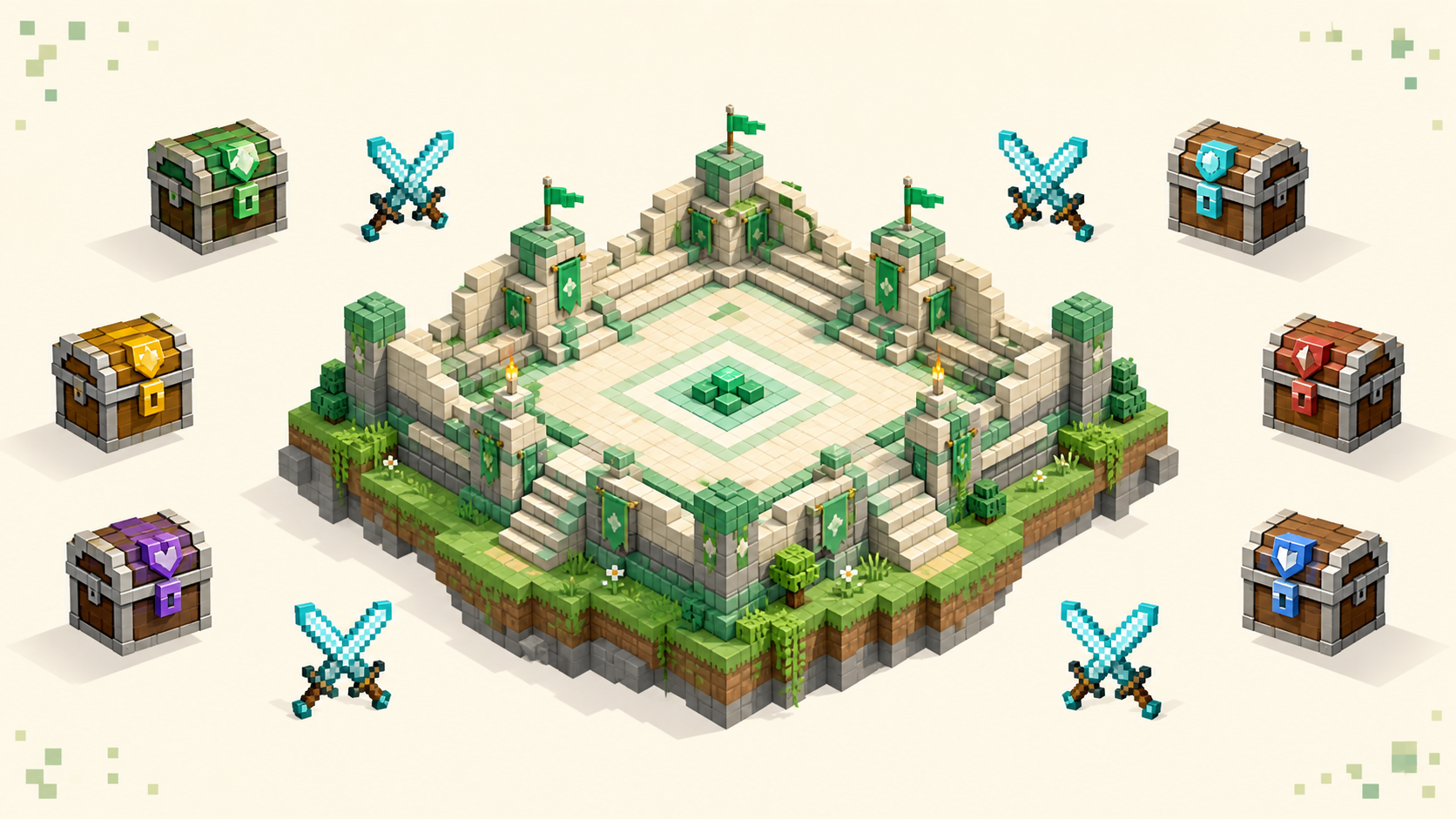
A KitPvP server comes down to two things: whether its anti-cheat actually catches reach and killaura in a crowded arena, and whether its kits are balanced enough that clicking and positioning decide the fight instead of whichever loadout is overtuned. KitPvP is open-arena Java PvP — you spawn, grab a preset kit of armor, weapon, and sometimes an ability item, drop into a shared free-for-all, and respawn back into the same kit every time you die. The cape effects and a twenty-kit menu don't matter if one kit outclasses the rest or half the lobby is hacking, so I'm not naming servers — the live KitPvP rankings already show which arenas are busy this month. What's worth your time is reading those listings for the handful of signals that separate a clean arena from a laggy, hack-ridden one.
What KitPvP actually is (and how it's not a duels server)
KitPvP is a persistent free-for-all. You join one shared arena, everybody in it can hit everybody else, and there's no matchmaking queue putting you in an isolated fight. You pick a kit from a menu — the access point is usually a compass in the hotbar that opens the kit GUI, a sign or NPC at spawn you right-click, or the /kit command typed straight into chat. Once you pick, the kit auto-gives and auto-refills, so there's no gear grind between deaths. You die, you respawn, you get the exact same loadout back, and you walk out of spawn to fight again.
Around that core you'll see the standard furniture. Killstreaks track your consecutive kills and usually announce a player who's on a tear, sometimes putting a bounty on them so the lobby turns and hunts them. A combat tag (the "combat log" prevention) marks you as in-combat for a few seconds after the last hit, so you can't just /spawn out of a losing fight. And a safe zone or spawn protection gives you a small no-damage bubble to pick your kit in, so you're not getting spawn-killed the instant you respawn.
That's the part people blur with the two adjacent PvP formats. A duels or PvP practice server queues you into an isolated 1v1 with a reset inventory and an ELO rating — you're matched, you fight one person, the inventory clears, you re-queue. Crystal PvP is one specific end-crystal-and-totem loop built on a totally different mechanic. KitPvP is the messy open arena where the loadout is preset and the fight never really stops.
Kit balance is what actually separates them
This is the criterion that's specific to KitPvP, and it's the one most people skip past looking at the kit count. What you actually want to know is whether any single kit is objectively the best pick.
Kits fall into two rough archetypes. Gear kits are plain: full diamond armor, an enchanted sword, maybe a bow and a few golden apples, and nothing else — the fight is entirely your clicking, aim, and strafing. Ability kits carry a gimmick: a leap item (the "Kangaroo" kit that launches you), a fire kit ("Pyro"), an archer kit with a heavy-knockback bow, or kits packing Strength potions or Notch apples. Ability kits are more fun to mess with, but they're also where balance goes wrong.
A balanced roster means no kit wins on selection instead of skill. Ability items sit on cooldowns, so you can't spam the leap or the fireball, and the base gear is comparable across kits so nobody's walking in with strictly better armor than everyone else. The red flag is one broken kit — the one where, if you fight two evenly matched players and one picked it, the kit decides the outcome before mechanics enter into it. When you test an arena, watch what the top of the killstreak board is running. If it's the same kit every time, that's your answer.
Worth being clear on one point: kit access here is a gameplay thing, not anything else. Better or extra kits are earned through progression — killstreaks, levels, or in-game vote rewards handed out as a gameplay mechanic. What matters for balance is that no kit is objectively dominant, however you unlock it.
Anti-cheat is the other half of the decision
A free-for-all arena is a magnet for cheats in a way a 1v1 never is, because there are more targets and more chaos to hide in. Reach, killaura, autoclicker, and velocity (no-knockback) hacks all steal kills directly, and in a crowd nobody can watch one suspicious player closely. So a server that takes the mode seriously runs a real, modern anti-cheat.
Two names worth recognizing. GrimAC is free, open-source, and simulation/prediction-based for the Paper family — it rebuilds each player's legal movement tick by tick and flags impossible actions like reach past about 3.01 blocks. Vulcan is a packet-level anti-cheat strong on the combat side: KillAura, Reach, AutoClicker, and the movement cheats. Competitive arenas often run both, because they cover slightly different ground.
You can't see the config, so judge anti-cheat by the observable. Is there active moderation? Do reports get handled fast? Is chat a wall of unanswered "this guy is hacking" accusations, or does someone with a tag actually respond? A tended server tells you it cares; a silent one that lets obvious reach run on the middle of the map has told you the opposite. There's a second failure mode, too — an anti-cheat tuned too aggressively will flag legit high-CPS clicking and kick clean players, which is as bad as having none, because you can't fight when a false positive ends the round. The way to check both is to play a session and watch whether your own honest clicking ever gets you flagged. How to choose a server anti-cheat goes deeper on reading these signals from the outside.
Ping, region, and TPS — the numbers under the fights
KitPvP is tight melee, so latency decides hit registration, knockback, strafing, and W-tap timing. Rough bands, and treat them as approximate: under about 40ms is excellent, 40–80ms is good, 80–130ms is playable with noticeable delay, and past roughly 130–150ms you get ghost hits and knockback that fires late or not at all. The fix is almost always region — filter the directory by location so you're only looking at hosts near you. What counts as a good ping for Minecraft breaks the bands down further, and if you're sorting by latency specifically, the rundown on low-ping PvP servers for European players walks through reading region against your own connection.
TPS is the separate number and it's easy to miss. A server targets 20 TPS, which is one tick every 50ms, and you want MSPT under 50ms during fights — not just while spawn sits empty. An arena that holds 20 TPS at an idle spawn but drops ticks the moment the lobby fills up will stutter on every hit, exactly when you need it clean. The tell is the same as ping's, but shared: if everyone in the arena rubber-bands at once when it gets busy, that's the server's TPS, not your connection. What TPS and MSPT are covers how to tell the two apart.
Population, and matching the combat version before you connect
An FFA arena with nobody in it teaches you nothing, so population is a hard requirement, not a bonus. Read the live concurrent count on the listing, and treat a fresh monthly vote count as the population proxy. Votes reset when the calendar month flips, so a top entry is active right now rather than living on a reputation it earned two years ago. Watch for hollow numbers the same way you would anywhere — a huge max-player cap parked next to a near-zero current count is a ghost town.
Combat version is the other thing to match before you connect. The 1.9 Combat Update added the per-attack cooldown that killed fast-clicking — swing too fast and your extra clicks land as chip damage. Because of that, KitPvP overwhelmingly runs 1.8 / 1.8.9 mechanics, either on a genuinely old build or by emulating old combat on a newer server with a plugin like OldCombatMechanics, so the fast-click, strafe, and W-tap style still works. Match your client to what the listing says or you get kicked with "Outdated client!" or "Outdated server!" before you ever swing.
The version numbers, so you can line them up: 26.3 "Wilderness Bound" is protocol 777, 26.2 "Chaos Cubed" is 776, 26.1 is 775, and a newer client can't join an older server. The plugin servers running Grim or Vulcan — the ones you actually want for KitPvP — run on the default Java port 25565 and usually sit on whichever version Paper marks as stable, which can trail the newest vanilla release for a while after a drop. If you'd rather not keep swapping installations, ViaVersion lets a server accept a range of client versions, and if you do hit the mismatch, fixing "Outdated server / Outdated client" walks through it.
Using the live rankings
The KitPvP rankings are ordered by votes earned this calendar month and reset when the month flips, so the top entries are the arenas active tonight, not whatever was big years ago. The workflow is short: shortlist two or three, join each, and fight a few real rounds before you commit. Watch for tick stutter when the lobby fills, ghost hits on your knockback, one kit dominating the killstreak board, and obvious hackers nobody's dealing with. Commit to the one that feels clean, then vote for it — voting is free, rate-limited per player, and it's how good arenas stay near the top where the next player finds them. How rankings work covers the mechanics.
The full server list stays current the same way, and you can narrow it. /servers/version/26.2 pulls arenas on a given version, and /servers/country/us pulls region-local hosts toward the top — both are just example paths, so swap in the version or ISO country code that matches your setup.
FAQ
What's the difference between KitPvP and a duels/practice server?
Third-partying. In KitPvP's open arena it's completely fair for a fresh player to jump into a fight you're already losing and clean up both of you, so you're never handed an even matchup. A duels server walls that off — you and one opponent start with equal gear and full health, and nobody else can touch the fight. Practice servers go a step further and split duels into named ladders like NoDebuff, Gapple, and Sumo, each with its own fixed loadout and its own separate ELO. And the KitPvP "match" never actually resolves; there's no win screen, you just keep respawning into the same arena until you log off. If you want the structured version, 1v1 practice servers cover it.
Why does KitPvP still use 1.8 combat?
Comboing. In 1.8, a landed hit staggers your opponent long enough that a fast clicker can chain three or four more hits before they recover, and that combo pressure is most of the skill ceiling in the mode. The 1.9 attack cooldown — the strength bar that fills under your crosshair and only deals full damage back at 100% — breaks that chain, so any click past roughly 8 to 10 CPS is wasted and fights slow to a back-and-forth trade. That's the whole reason arenas either stay on an old 1.8.9 build or switch the cooldown back off with a plugin on a newer version. One catch worth knowing: that emulation only changes how combat feels, not what protocol the server speaks, so you still match your client to the listing's version regardless.
Which kit should a beginner pick?
Start with a plain gear kit — full diamond and an enchanted sword, no gimmick — because it lets you drill the fundamentals, strafing and W-tapping, without anything else to think about. Ability kits like archer, leap, or pyro add a cooldown you have to manage on top of the fight, and juggling that timing while you're still learning to aim usually just gets you killed. Once your clicking and positioning are solid, move to an ability kit and treat the cooldown as one more thing to time.
What is the combat tag, and why can't I use /spawn mid-fight?
While you're combat-tagged — usually about 10–15 seconds after the last hit you took or landed — commands like /spawn and /kit are blocked, and logging out kills you or drops your inventory on the ground. That's the anti-combat-log rule working as intended, not a bug: it stops players from escaping a losing fight by teleporting or disconnecting. Your options are to wait for the tag to clear or to win the fight, and the timer resets every time a new hit lands, so running only works if you actually break contact.