Best EggWars Servers: How to Pick One
Pick an EggWars server by whether its games fill and start, how well its anti-cheat holds up over the void, and whether every round begins on even footing.
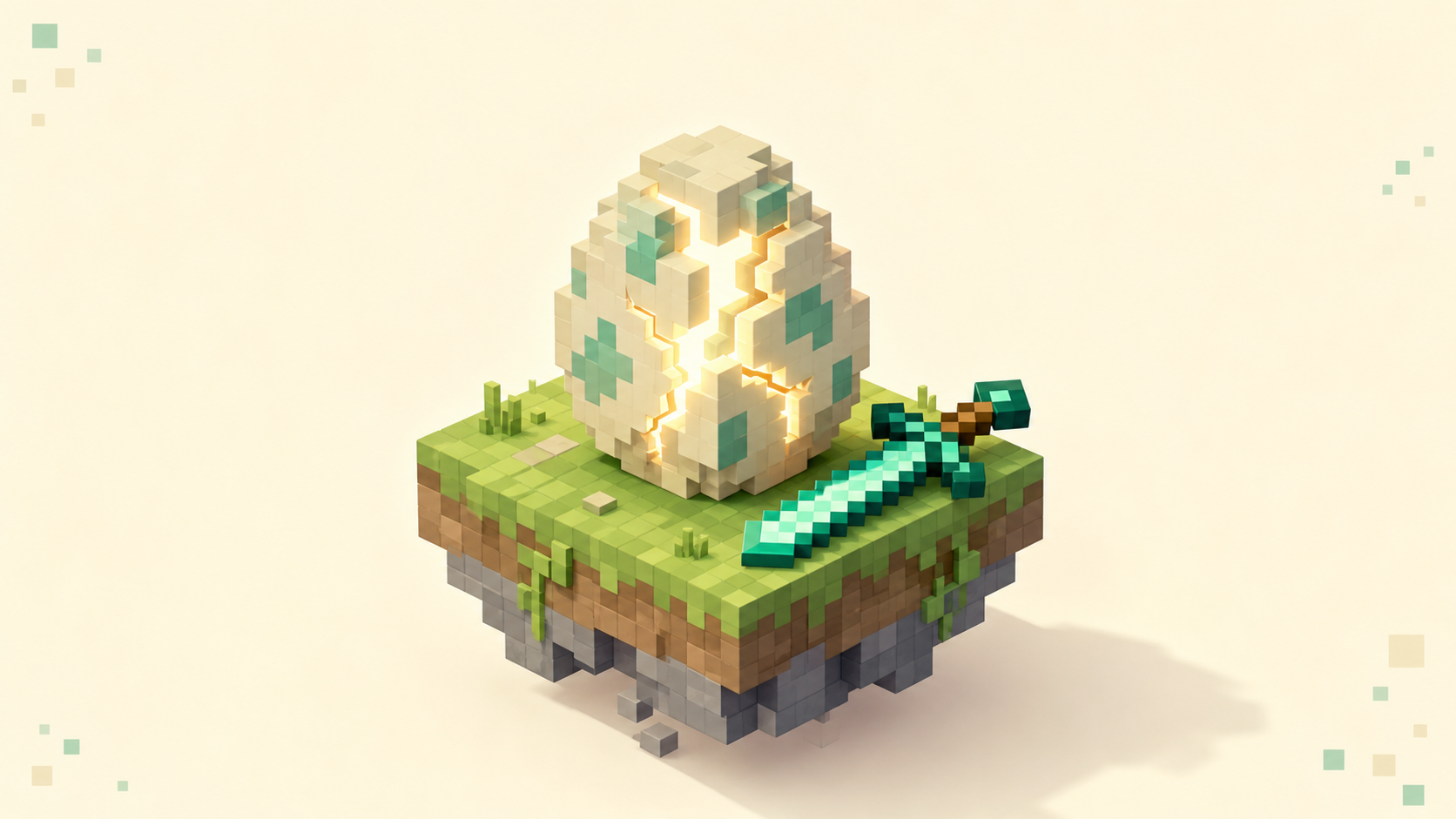
Pick an EggWars server by whether its games actually fill and start. A good map pack means nothing if the lobby countdown keeps resetting on a half-empty queue, so that comes first. After that, weigh how well the anti-cheat holds up over open void, and whether everyone drops into the round on equal footing. Those matter more for your night than the map pack or the lobby music, because EggWars is a fair fight above nothing and it comes apart the moment one of them slips. The mode itself is easy to describe: each team guards one egg on a floating island, and as long as that egg is intact, a teammate who dies just respawns back on the island. Smash the enemy egg and their respawns stop. That is not the same as winning, and the gap between those two things is where most new players lose.
How a round of EggWars plays out
You spawn on your team's island with your egg sitting on a small pedestal. It's rendered as a dragon egg block, so it's easy to spot. Around you are resource generators that drip iron, gold, and diamond onto the ground on separate timers. Iron comes fast and cheap, gold is slower and worth more, diamond is the slow top tier. Some maps add emerald as a rarer fourth. The generators are usually unbreakable, and on most servers you can upgrade them: feed resources back in to raise a generator's tier so it produces materials quicker.
Those raw resources are the currency. You carry them to a shop villager and trade for what you need: bridging blocks, armor, a sword, a bow with arrows, a pickaxe, sometimes TNT or golden apples. Cheap stuff like blocks and basic gear runs on iron, better armor and weapons cost gold, and the strongest gear and specialty items want diamond. There's no separate money here; the ore in your inventory is the price.
Then you leave. You bridge across the void with blocks toward an enemy island, fight your way on, and break their egg so that team can't respawn anymore. After that you hunt down whoever's left until your team is the last one standing. Falling off is a death like any other, so the bridge is half the game.
The one rule people always get wrong
Breaking the enemy egg does not kill anyone who's currently alive. It only takes away their respawns. Everyone standing on that island keeps the life they've got and has to be killed one more time before they're actually out. This is the single most misread rule in the mode, and it costs games. A player smashes an egg, assumes that team is finished, turns around to farm, and the "dead" team bridges straight back and breaks his egg while he's away. A broken egg is a countdown, not a kill. Treat it that way and clean up the survivors before you relax.
How it's different from Bedwars and Skywars
If you've played the other two, EggWars sits between them. Bedwars gives each team a bed to defend, which works the same respawn-until-destroyed way, but the block is a bed and the economy leans on base generators plus a scramble for the map center. Skywars has no respawn structure at all: you get one life, you loot chests on your island and in the middle, and last player alive wins. EggWars keeps a respawn structure like Bedwars but pairs it with spawn-island generators, so it's less about a mad center rush and more about defending your island while you build up.
| Mode | Respawn structure | Where resources come from | Out when |
|---|---|---|---|
| EggWars | The egg (dragon egg) | Generators on your spawn island | Egg gone, then you die |
| Bedwars | The bed | Base generators plus map-center gens | Bed gone, then you die |
| Skywars | None | Loot chests, no team generators | You die, full stop |
Two habits carry over badly. Coming from Skywars, people forget they respawn and throw their life away early. Coming from Bedwars, people go hunting for a bed to break instead of an egg. If you want a fuller look at either one, the Bedwars and Skywars guides cover them on their own terms.
Populated queues, or nothing starts
EggWars is round-based, so a match needs a minimum number of teams before the lobby countdown will fire. On a quiet server, or during off-peak hours, the big multi-team maps at eight teams and up just never fill, and the countdown keeps resetting or the game finally starts half-empty and lopsided. This is why a live player count is a real selection tool, not a vanity number. Before you commit, look at how many people are actually on and in the format you want. Solo, doubles, 3s, and 4s all exist, with map size scaled to fit, and the smaller, faster maps fill far more reliably on a slow night than a 64-player map ever will.
That's the honest case for checking rankings by current activity rather than reputation. The site's live vote-ranked minigames list sorts by what people are playing right now, so you can pick a server that's busy tonight instead of one that was busy last year. If you mostly want short sessions, the quick-session minigames guide is aimed at exactly that. The same shelf holds the calmer end of it too — prop hunt servers if you want a round with no combat in it at all.
Anti-cheat that actually removes cheaters
Cheating hurts more in a void game than anywhere on solid ground, so weight this heavily. Two hacks in particular wreck EggWars. Reach lets someone land melee hits from past the roughly three-block vanilla range, which means they tag you before you're close enough to fight back on a bridge. Anti-knockback, or velocity, cancels the shove that would normally punt a player off a one-block path. A cheater with it barely moves when you hit them, and you can't push them into the void the way the map intends. Killaura and autoclickers show up too.
You'll see servers advertise a plugin by name: GrimAC, Vulcan, NoCheatPlus (often written NCP), AAC. Useful to know, but the name proves nothing on its own. A well-known anti-cheat that's badly tuned still lets blatant reach and anti-knockback cheaters run the lobby. Judge a server by whether obvious cheaters actually disappear. Play a couple of rounds, watch how fly and reach get handled, and see if reports go anywhere. The anti-cheat guide goes deeper on reading a server this way instead of trusting the badge.
Equal starts and balanced kits
The fairness question for EggWars is simple: does everyone begin the round on identical footing? A clean server drops all players onto their islands with the same empty inventory and the same generators, so the only edge anyone has is how they farm and fight. Watch for starter kits that hand some players extra armor, a weapon, or a stack of resources before the first generator has even ticked. That skews the opening minutes, which in a fast mode is a big chunk of the whole match. You want kits that change how you play, not ones that hand out a combat lead at the horn. A quick scan of the lobby before you queue usually tells you which kind of server you're on.
Java, Bedrock, and cross-play
EggWars runs on both editions, but how they connect matters. Java Edition joins on TCP port 25565; Bedrock Edition joins on UDP port 19132. Cross-play EggWars almost always means a Java server running Geyser and Floodgate so Bedrock clients can drop into Java matches. Plenty of networks instead keep separate Java and Bedrock lobbies that never share a queue, and some run native Bedrock-only setups. So a Java hub serves Java clients, while a cross-play lobby built on Geyser can put Bedrock and Java players in the same game.
The catch is that Bedrock and Java don't automatically mix just because both are online. If you and a friend are on different editions, check that the server actually bridges them before you expect to team up, or you're on two ports and two queues that never meet. The site's cross-play list filters for servers that do bridge, and the Bedrock-and-Java explainer walks through how that works.
While we're on versions: this world runs the 26.x line, with 26.3 the latest (protocol 777) and 26.2 the one before it (protocol 776). If you join on the wrong client you'll usually get an "Outdated client!" or "Outdated server!" message. That's a version mismatch, not a broken server. Match the protocol and try again rather than reinstalling or blaming the host.
A round, start to finish
- Spawn, and box in your egg before anything else. An open egg is a free kill for the first enemy who bridges over while you're farming.
- Stand by the generators and collect iron, gold, and diamond as they drop. If you can spare it and the server allows it, upgrade a generator's tier for faster output.
- Take your resources to the shop villager. Buy bridging blocks plus armor, a sword, and a bow with arrows: iron for the cheap items, gold for mid gear, diamond for the best.
- Bridge toward an enemy island on cheap, fast blocks. Watch for bow knockback and for enemy bridges converging on yours; one hit over open void is a death.
- Get onto the island and break their egg, the dragon egg on its pedestal, to cut their respawns.
- Clean up the now-respawnless enemies. Remember the egg didn't kill them, so their next death is the one that counts. Then move to the next island and do it again until your team is last standing.
For defending, spend a little more on blast-resistant blocks like end stone or obsidian around the egg. They shrug off TNT and slow a pickaxe far better than wool. Keep the cheap wool or sandstone for bridging, where speed matters more than toughness.
FAQ
I matched the protocol and it still says Outdated. Now what?
The version number on the server list is a ping, and on a big proxy network that ping sometimes reports the hub's version rather than the EggWars game server sitting behind it. So the lobby can look current while the actual match server lags a release behind. If you're sure you're on 26.3 and it still bounces you, drop your client to 26.2 and try again, since networks often update the hub first and the game servers later. It's also worth deleting the saved server entry and adding it fresh, because a stale cached ping can keep showing the old status after the host has moved on.
I broke two enemy eggs and still lost the fight. What went wrong?
Breaking an egg does nothing to the players standing on that island right then, so if you crack it and immediately charge into three geared defenders, you're fighting the same numbers you would have with the egg intact. The break only pays off later, once those players start dying with no way back. Smash the egg, then pull back onto a bridge or a choke and let them come to you, where every death they take is permanent and yours is not. Rushing the kills the instant the egg pops is how you hand a "finished" team the whole fight.
Does playing on Bedrock in a cross-play match put me at a disadvantage?
Aim and combat translate fine, but bridging is where the input gap shows. Fast diagonal bridging across the void is easier with mouse and keyboard than with touch or a controller, and on a Geyser-bridged server the Bedrock and Java players are in the same race to the middle. That's not a rule the server sets; it's just how the inputs differ. You can absolutely keep up with practice, but if your bridges feel slower than your Java friend's, that's usually the reason rather than anything the host did.
Can a teammate break our own egg, and is anything on my island safe?
The generators and the shop villager are normally unbreakable, so you don't have to guard those. Whether your own egg can be mined by a teammate depends on the server. Some protect it from friendly fire, some don't, which opens the door to griefing. If you're playing with randoms, it's worth a quick test or a look at the rules before you trust the person next to you with a pickaxe.