Best Crystal PvP Servers to Practice On
How to pick a crystal PvP server worth practicing on — judge TPS, ping, anti-cheat, kits, and population, then use the live PvP rankings.
A good crystal PvP server is one that holds 20 TPS during a fight and gives you a clean, low-ping connection, because the entire style lives or dies on packet timing. Crystal PvP is the fast Java combat game built on end-crystal explosions, totems of undying, and full enchanted netherite — you place a crystal next to your opponent, instantly detonate it, and race to burn through their totems faster than they can re-equip. Every part of that loop depends on the server processing your placement, hit, and totem swap on time, so a laggy host doesn't just feel bad, it breaks the mechanics. I'm not going to name servers here, because the live PvP rankings already show which communities are active this month. What helps is knowing how to read those listings for the signals that decide whether a practice server is usable.
What crystal PvP is actually testing
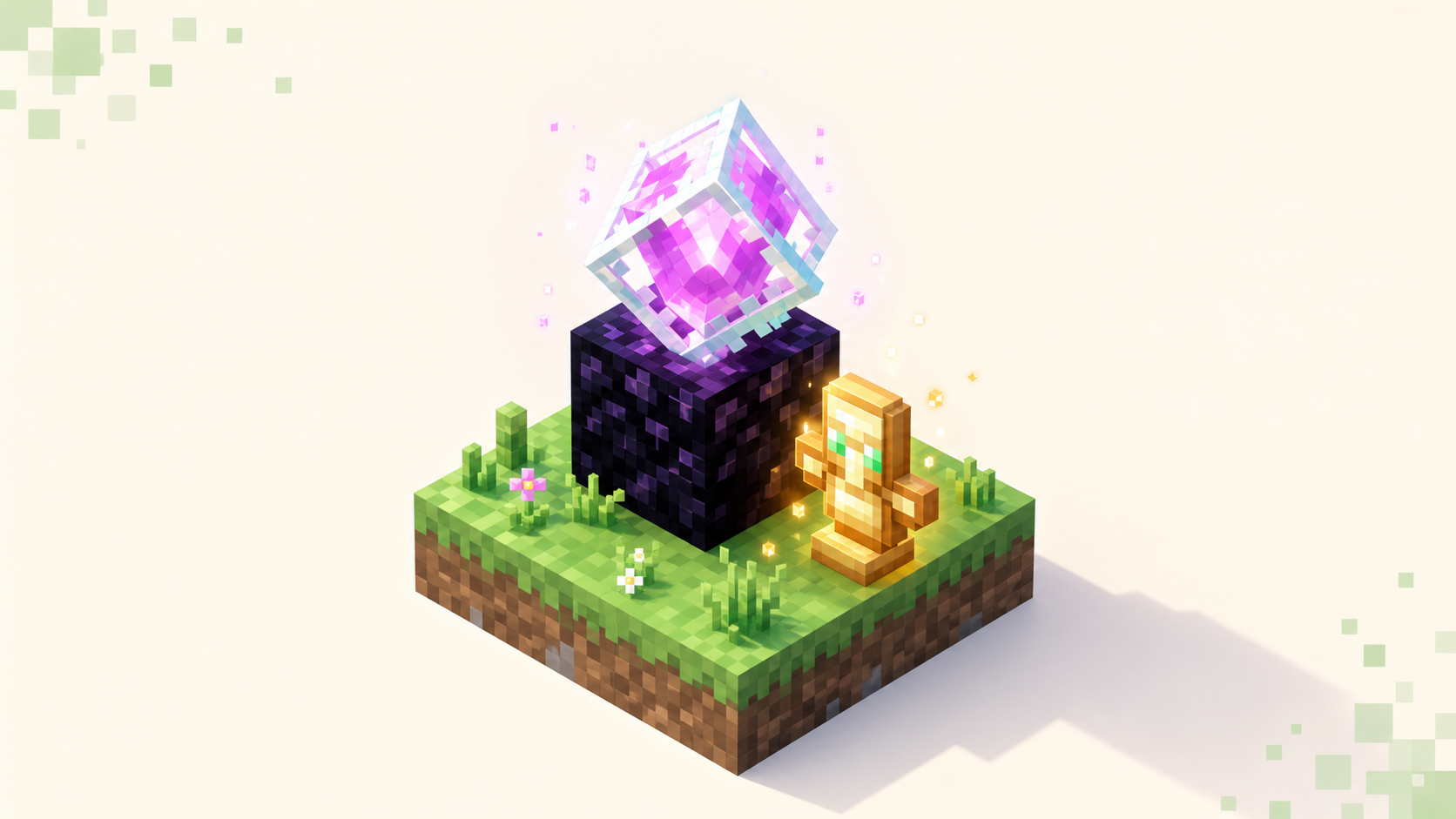
You place an End Crystal on obsidian or bedrock — those are the only two blocks it sticks to — and it explodes with the force of a charged creeper the instant anything damages it, even a hit that would normally deal zero damage. That's why players place a crystal and immediately punch it: the explosion lands next to the target before they can react.
Two details make this a skill instead of spam. First, the crystal doesn't break the obsidian under it, so good players lay down obsidian platforms to protect their footing and keep placing. Second, positioning is everything. A crystal does maximum damage when the target's feet are level with or below it, and a crystal placed one block too high does almost nothing. That same-Y-level placement under pressure is the core mechanic the practice arenas exist to drill.
The defensive half is the Totem of Undying. Held in your main hand or off-hand — it does nothing sitting unselected in the hotbar — it auto-pops on otherwise-fatal damage, restoring you to 1 HP and handing you a brief window of Regeneration II, Fire Resistance I, and Absorption II. Skilled players keep one in the off-hand and instantly pull another from the hotbar after each pop, which is the move everyone calls totem swapping. The fight is won by out-placing and out-swapping the other player, and none of that survives a server that can't keep up.
The signals that actually decide a practice server
TPS and MSPT come first
A server targets 20 TPS, which is one tick every 50 ms. When a tick runs long the next one is delayed and the lag compounds, and below roughly 15 TPS it's noticeably rough. MSPT — milliseconds per tick — is the same thing read per tick, and you want it comfortably under 50 ms during combat, not just while spawn is empty. A crystal server that drops ticks when two players actually fight is unusable, because your explosions, totem pops, and obsidian placement all stutter at the exact moment they need to be frame-perfect.
Ping is the other make-or-break number
Roughly under 40 ms is excellent, 40–80 ms is good, 80–130 ms is playable with noticeable delay, and above about 130–150 ms you get ghost hits, blocked crystal placement, and knockback that fires late or not at all. Minecraft's server doesn't fully rewind for your latency in combat, so high ping turns directly into missed hits and erratic knockback — and in a style where one mistimed totem swap loses the round, that's fatal. Pick a region close to you, and filter the directory by location so you're only seeing nearby hosts. If you're sorting by latency specifically, the rundown on low-ping PvP servers for European players walks through how to read region against your own connection.
Anti-cheat that catches hacks without punishing clean players
Crystal PvP is a prime target for reach, killaura, aim-assist, and auto-totem cheats, so a credible modern anti-cheat is load-bearing. GrimAC is a free, open-source option for Paper-family servers that simulates a 1:1 replica of each player's legal movement with latency compensation and flags impossible actions like reach past about 3.01 blocks. Vulcan is a packet-level anti-cheat covering KillAura, Reach, AutoClicker, AimAssist, and the movement cheats, and a lot of competitive servers run both together.
The part people forget is the other failure mode. An anti-cheat that randomly kicks or flags a clean player for fast clicking or a momentary lag spike is as bad as having none — you can't practice technique when a false positive ends the fight. A server with a tuned, low-false-positive setup is the one you want, and the only way to confirm it is to play a session and watch whether legitimate high-CPS clicking ever gets you flagged.
Real kits, real population
The practice-specific features are easy to check. You want dedicated arenas or kits that auto-give and auto-refill obsidian, end crystals, totems, golden apples, and full netherite, so you're drilling the fight instead of regrinding gear between every round. Ranked or matchmaking queues help you find opponents near your level, and spawn protection keeps a no-grief practice zone from turning into a spawn-camp. Above all you need a healthy live population — an empty arena teaches you nothing. If you're after structured one-on-one drills rather than open arenas, the guide to PvP practice servers for 1v1 covers that side in more depth.
Red flags to skip
- Tick lag during fights. If placement and totem pops stutter the moment two players engage, the host can't hold 20 TPS under load — skip it.
- A region that's wrong for you. A server full of players 150 ms away will feel sluggish no matter how good its hardware is.
- No anti-cheat, or a trigger-happy one. Both ends are bad: unchecked reach and aura hacks make practice pointless, and an anti-cheat that flags clean clicking makes it impossible.
- A ghost-town arena. A real, recent player count matters more than a big max-player cap sitting next to a near-zero current count.
- Legacy 1.8 "no cooldown" only. Modern crystal PvP is built on 1.9+ combat with the attack-strength cooldown. A server stuck on pure 1.8 mechanics isn't training the style most people mean by crystal PvP.
Matching the version before you connect
One mismatch will stop you before any of this matters: your client and the server must share the same network protocol. Right now 26.3 "Wilderness Bound" runs protocol 777, 26.2 "Chaos Cubed" runs 776 and 26.1 runs 775, and a newer client can't join an older server. As of September 2026, Paper's stable builds are for 26.2 and its 26.3 builds are still experimental, so plenty of plugin servers sit a drop behind the game, or further back on 26.1 when their anti-cheat or other add-ons require it. So if you've just updated your client and a server kicks you with Outdated server! I'm still on 26.2, that's the server lagging behind your version, not a fault on your end. Match the listing's version before you connect and you skip the whole problem.
Using the live rankings
The PvP rankings are ordered by votes earned during the current calendar month, and the count resets when the month flips, so the top entries are the communities that are active right now rather than whatever was big years ago. Pull a shortlist of two or three, join each, and run a real fight before you commit — most players bounce between a few arenas before one feels right. When a server clicks, vote for it; that's free, rate-limited per player, and it's how the good practice communities stay near the top where the next player finds them. The full server list and the homepage rankings stay current the same way.
FAQ
Does a totem save me from everything?
No, and the gaps matter in an arena. A Totem of Undying only triggers on damage that would otherwise kill you, and it does nothing against void damage, the /kill command, or a Harming arrow's raw physical kill. That's part of why arena fights stay crystal-and-sword exchanges instead of cheese kills — the totem covers the explosion and melee race, not the instant-death tricks.
What about respawn anchors — are they used in crystal PvP?
They're the secondary explosive. You charge a Respawn Anchor with glowstone, up to four charges shown on the side dial, and trying to use a charged one outside the Nether triggers a power-5 explosion that sets nearby blocks on fire. It's weaker than an end crystal but stronger than TNT, and a kill from one prints (Player) was killed by [Intentional Game Design]. Some arenas allow anchor practice alongside crystals; many keep it crystal-only, so check the kit.
Which armor enchant should my practice kit have?
Blast Protection. It cuts explosion damage by 8% per level — Blast Protection IV is 32% off — and in Java it also reduces explosion knockback by 15% per level, which keeps you from getting launched out of placement range. The catch is that Protection, Blast Protection, Fire Protection, and Projectile Protection are mutually exclusive on a single piece, and the Protection family stacks only to an 80% damage-reduction cap, so a kit that lets you swap enchants is letting you test a real strategic trade-off rather than handing you one fixed loadout.
How do I tell a server's lag is the server and not my connection?
Watch the two numbers separately. High ping is your latency to the host and shows up as ghost hits and late knockback that get worse the farther the server is from you; low TPS is the server itself falling behind and shows up as everyone stuttering at once, usually right when a fight starts and load spikes. If a friend on a different connection sees the same stutter at the same moment, that's the server's TPS, not your ping — and no amount of switching regions will fix it.