Best PvP Practice Servers for 1v1 Duels: How to Pick One
How to choose a Minecraft PvP practice server for 1v1 duels — kit presets, ping and region, queue health, and anti-cheat — then use the live vote rankings.
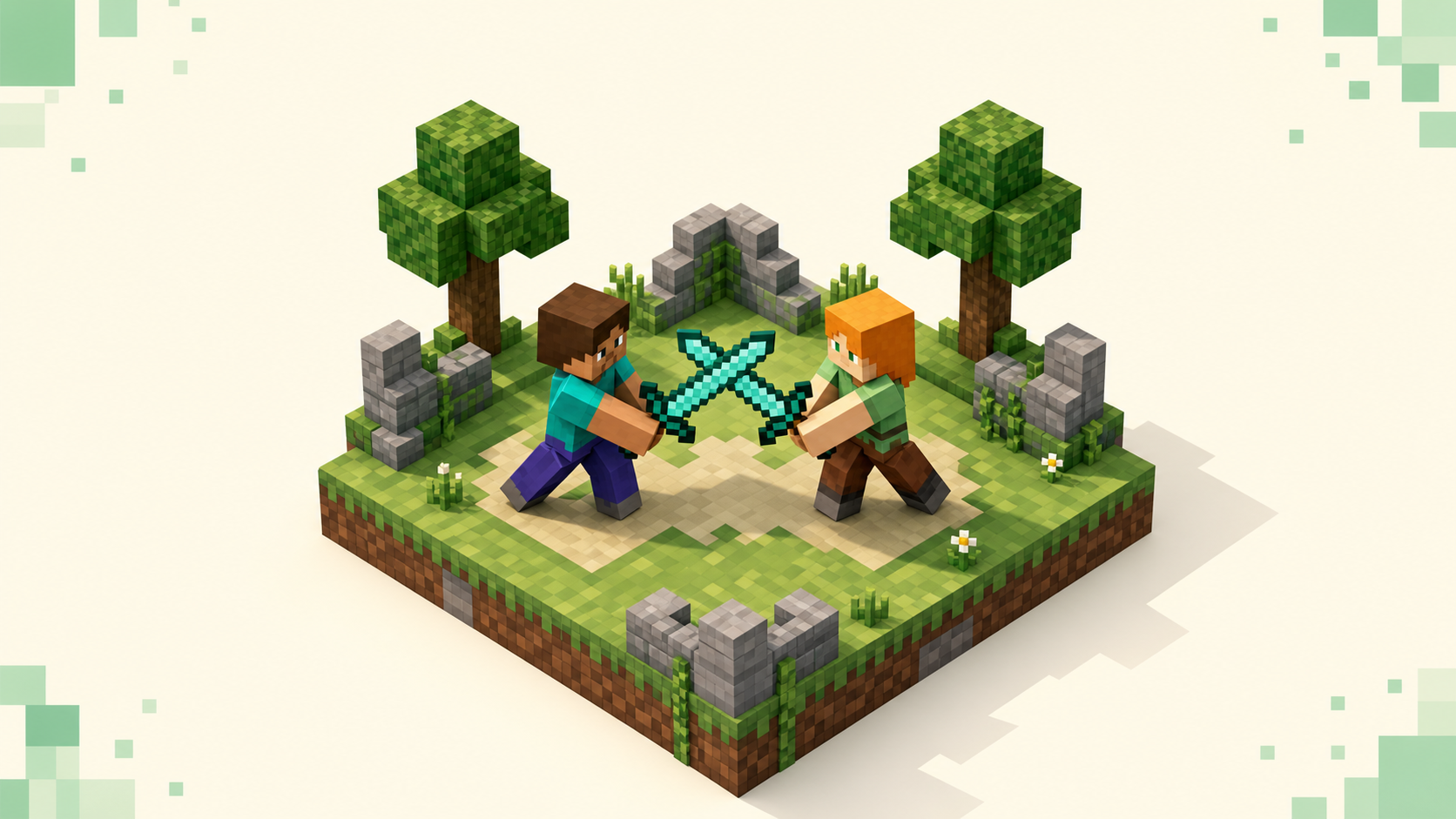
The thing that actually decides a 1v1 server is whether its queue pops and whether hit registration is clean — the kit count and the lobby cosmetics barely move the needle. A frozen "best" list goes stale in a month anyway, so what's useful is knowing how to judge a practice server yourself. The most active PvP servers right now sit on the PvP rankings, ordered by this month's votes, which is where to find one that's actually populated tonight.
What a "practice" or duels server actually is
If you've played KitPvP but never a dedicated practice server, the format is simpler than it sounds. You queue, you get matched against another player who queued the same mode, you drop into an arena with a preset loadout, you fight, and a result screen tells you who won. Your inventory resets every round, so there's no gear to keep and nothing to lose, and then you re-queue. That's what separates a duels server from open-world PvP like Factions or anarchy — there's no gear to grind and no walking across a map to find a fight, you just queue and fight again, which is the point when you're drilling mechanics. If you're still mapping out the wider gamemode landscape, Minecraft server types explained lays them side by side.
Around the core 1v1 you'll usually see a few other modes: free-for-all arenas, ranked queues with an ELO rating versus casual unranked ones, and party or 2v2 for fighting with a friend. They're worth having, but the thing to judge a practice server on is whether its 1v1 is clean. A lot of these live under both the PvP and minigames sides of the directory, so browse /servers/pvp and /servers/minigames both.
Kit presets: the modes that define a duels server
The kit list is the heart of a practice server, because each preset is really a different game. The common ones you'll see are NoDebuff, Gapple, Combo, Sumo, Soup, Boxing, BuildUHC, and Axe. A few worth knowing if you're picking what to grind:
- NoDebuff is the classic potion fight — full diamond, you spam healing pots, and the skill is managing them without taking debuff pots. This is the mode most competitive players live in.
- Sumo strips it down to knocking your opponent off a small platform, so it's pure movement and knockback timing with no gear at all.
- Combo tunes the knockback so you can chain hits once you land the first one and your opponent can't easily escape it.
- Boxing is first to a set number of hits with no armor, which makes it about clicking and aim rather than survival.
The quality signal is whether the server lets you build and save your own kits — a kit editor so you can lay out your hotbar how you like it and store a few variants, rather than locking you to one fixed loadout. The other thing, and it matters more than the kit count, is whether players are actually queuing your mode. A server with fifteen kits and an empty NoDebuff queue is worse than one with three modes that all pop in seconds.
Combat version: why 1.8 mechanics still rule duels
The Combat Update in 1.9, back in 2016, added a per-attack cooldown to melee. After you swing, you have to wait roughly a second before your next hit does full damage, and that one change pulled the fast-clicking out of combat. Spam clicks now and you just deal chip damage.
That's why competitive duels and practice communities overwhelmingly run 1.8 or 1.8.9 mechanics instead. Old combat has the higher skill ceiling — clicking speed, strafing, and W-tapping all matter, and fights are faster. It's a community preference rather than an official ruling, but a strong and consistent one, and most serious practice servers run on it.
The practical part is matching your client to the server. Some run on 1.8.9 directly and you launch that version; others emulate old combat on a newer build, so you join on a current client and the server handles the mechanics. Check which before you queue, because a version mismatch throws "Outdated client" or "Outdated server" and just won't connect. How to join a server walks through switching installations in the launcher if you hit that. On the directory, every listing shows the supported version, and you can filter by dotted version paths like /servers/version/26.2.
Ping and region: the single biggest factor in a fair 1v1
In a duel, your ping matters more than almost anything else on the listing. Latency decides hit registration, crits, strafing, and W-tap timing far more than it ever does on a survival server, because everything is tight and there's no margin to hide behind.
Rough bands, and treat these as approximate rather than hard cutoffs: under about 60ms is excellent and genuinely competitive, under about 100ms is solid, and once you pass 130ms you start feeling a real disadvantage in close fights. Past 180ms or so your hits land late and the whole thing desyncs.
The fix is almost always region. Pick a server hosted near you — NA-East, NA-Central, NA-West, EU, Asia, Oceania, and Brazil are the common ones — because a 30ms NA player dropped onto an EU box will feel every bit of that desync. The country filter takes an ISO code and pulls region-local hosts toward the top. And in the Multiplayer list, the signal bars give you a live read before you join, so treat a red, high-ping bar as a reason to keep looking rather than something to push through.
Queue health: a duels server is only as good as its opponents
The way a practice server actually fails is a dead queue. You can't 1v1 with nobody online, and a server with every kit and perfect ping is useless if it takes three minutes to find a fight. Screen for this first.
What to look at: the live player count on the listing, whether your specific kit queue pops within seconds when you join, and whether the population holds at the hours you actually play. That last one catches people out, because a server packed at peak EU can be a ghost town when NA is awake.
This is where the monthly vote rankings double as a population check. A server near the top of the PvP rankings this month almost always has the busiest queues, because votes track communities that are active right now rather than ones that were big years ago — how rankings work covers the mechanics. So the rankings aren't just a popularity board, they're a decent proxy for whether your queue will pop.
Tip: Open the two or three top-ranked PvP servers, queue your main kit on each, and keep the one that pops fastest at your hours. Queue speed at your real play time beats any feature list.
Anti-cheat: why one hacker ruins the whole server
For dueling this isn't a nice-to-have, it's a buying criterion. Duels are pure mechanical skill, so a single opponent on reach or killaura doesn't just win — the match stops meaning anything. Modern practice setups run detection for flight, killaura and aimbot, reach, and autoclicking, and the most respected competitive servers are known specifically for strong anti-cheat.
You won't get to see the detection code, so judge it by what's observable: moderation. Active staff who are actually around, reports that get handled quickly, and a community that isn't full of unanswered "this guy is cheating" complaints all tell you the server is tended. The reverse is just as clear — chat full of cheat accusations and nobody with a tag responding is your answer. Frame it the same way you'd frame uptime: a server can have perfect kits and low ping and still be unplayable if hackers run unpunished, so anti-cheat sits in the same tier of requirement, not the bonus column.
Red flags to avoid
Run down this list before you commit an evening to a server:
- Dead or near-empty queues at your play hours. The most common problem and the most fatal — nothing else matters if you can't get matched.
- High or unstable ping, or wrong-region hosting. It desyncs your hits, and no amount of skill fully compensates for it.
- Frequent downtime. Check the uptime on the listing; an offline server is an empty queue by default.
- No visible moderation, or a community openly complaining about cheaters who never get punished.
- Stale or confusing kit setups with no custom-kit support, or a combat version that doesn't match what you're trying to practice.
Using the live rankings to find your server
Don't chase a frozen "best" list, because the real picks move every month. Open the PvP rankings, which reorder by votes and surface the servers people are actively playing now. Cross-check minigames too, since some duel and practice servers list there, and narrow by version or country to match your client and region. If you'd rather just see everything at once, the full server list is there too.
From there it's three steps. Shortlist three, test queue speed and ping on each, and commit to the one that pops your kit fastest with clean hit reg. And if a server clicks, vote for it — votes are how the board stays current, and how the next dueler finds an active server instead of an empty one, which is the whole point of how rankings work.
FAQ
What's the best Minecraft version for 1v1 duels?
For competitive duels, 1.8 or 1.8.9 combat is still the standard, because the Combat Update in 1.9 added an attack cooldown that slows melee and removes the fast-click skill. Many servers either run on 1.8.9 directly or emulate old combat on a newer build, so check the supported version on the listing and match your client — that also avoids the version-mismatch error covered in how to join a server. You can filter by version at paths like /servers/version/26.2.
My ping is fine but my hits still miss — what's going on?
A low ping number doesn't help if the connection itself is jittery, so look at stability, not just the average. A wired connection beats Wi-Fi here, because Wi-Fi spikes mid-fight in a way a steady cable doesn't, and those spikes are exactly when hits desync. Background downloads, a roommate streaming, and an overloaded router all do the same thing. Combat version matters too — if you're swinging at old-combat speed on a server running 1.9 mechanics, you're outrunning the attack cooldown and your extra clicks land as chip damage rather than misses.
How do I tell if a practice server's queue is actually active?
Check the live player count on the listing, then join and queue your main kit — on a healthy server a 1v1 should pop within seconds. Population swings by region and time of day, so test at your own play hours instead of trusting a peak-time screenshot. The PvP rankings are a strong shortcut here: servers near the top this month are the ones with active communities, since the board orders by current-month votes.
Why does anti-cheat matter so much on a 1v1 server?
Because duels are pure mechanical skill, one opponent using reach, killaura, or an autoclicker invalidates the whole match. Dedicated practice servers run detection for those exploits, but the signal you can actually check is moderation: active staff, fast report handling, and a community that isn't full of unanswered cheat complaints. Treat anti-cheat quality the way you treat uptime — a core requirement, not a bonus.