What's New in Minecraft 26.3 Wilderness Bound
Everything in Minecraft 26.3 Wilderness Bound, from the dappled forest and poplars to abandoned camps, explorer maps, straw beds, cushions and wool stairs.
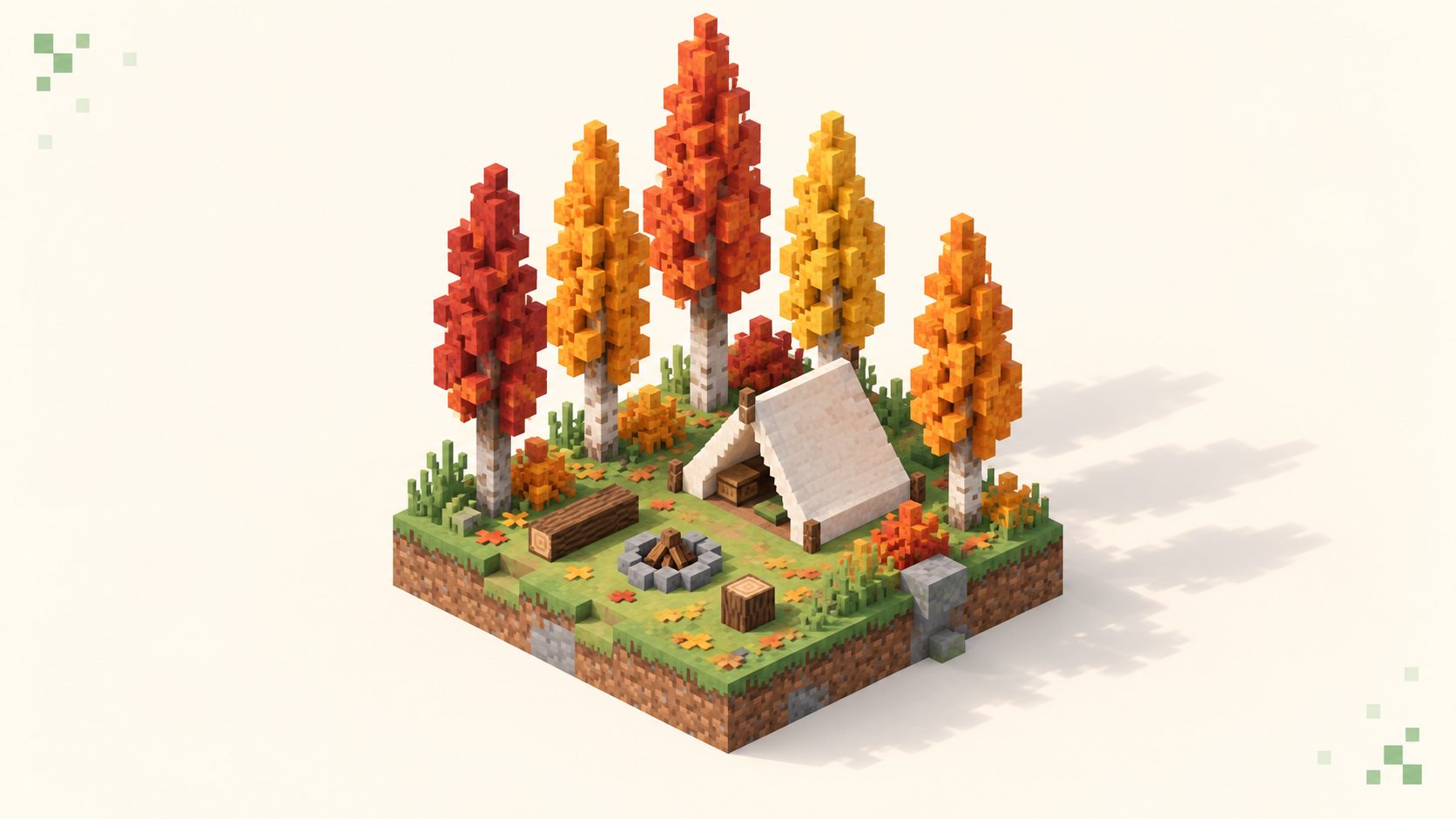
Minecraft 26.3 "Wilderness Bound" came out for Java on September 15, 2026, and most of the new content is built around one new biome, the dappled forest, an autumn-colored forest of red, orange and yellow poplars. Around it you get a new wood set, a new shrub and mushroom, abandoned camps in 18 biomes, reworked explorer maps, straw beds, cushions, and wool and concrete stairs and slabs. There's no experimental toggle on Java this time, so it's all in the base game once you update. There are no new mobs, music or enchantments. If you skipped the last drop, what changed in 26.2 covers Chaos Cubed.
The dappled forest
Mojang only says it's found "near cold biomes." The Minecraft Wiki adds that it generates in cold, dry areas and borders plains, sunflower plains, ice spikes and cherry groves, never another woodland biome.
The grass is tinted orange, the water is unusually dark, and each leaf color drops falling-leaf particles to match. The ground is covered in leaf litter, coarse dirt, brown mushrooms and patches of red shrubs, fallen poplars are more common than fallen trees in other forests, and the odd spruce turns up among them. Sheep, chickens, cows, pigs, rabbits and foxes spawn there, with the cows, pigs and chickens in their cold variants.
The biome now counts toward "Adventuring Time," so add it to the list if you're still working on that advancement. With cheats on, /locate biome minecraft:dappled_forest points to the nearest one, and our guide to finding the dappled forest covers where to look in survival.
Poplar trees and the poplar wood set
Poplars have light-brown logs and red, orange or yellow leaves. Leaves of any color drop poplar saplings, and each sapling grows into a random one of the three colors, so you can't pick the color by picking the leaves. The wiki says saplings need light level 9 or higher and room above them. The wandering trader can also offer saplings at 5 emeralds each, or 8 poplar logs for an emerald.
The wood set is complete, from logs, wood and their stripped versions through planks, stairs, slabs, fences, gates, doors, trapdoors, buttons, pressure plates, signs, hanging signs and shelves, plus a poplar boat and a boat with chest. Recipes follow the usual wood pattern, for example 6 stripped poplar logs and 2 iron chains for 6 hanging signs.
Red shrubs and shelf mushrooms
The red shrub is a small decorative plant that grows in patches on the dappled forest floor. Builders will like that it isn't biome-tinted, so it stays the same red wherever you plant it. Bone meal spreads a new shrub into an adjacent space if there's room, and shrubs are compostable, but there's no potted version.
Shelf mushrooms grow on poplar trunks, standing or fallen. Bone meal turns a small one into a large one, which drops 2 when broken. They're slightly bouncy, the way beds are, but they won't save you from a fall. According to the wiki you still take a little under half the normal damage, which is plenty to kill you from a real height. Mushroom stew and suspicious stew now accept "2 of any mushroom," so shelf mushrooms work there, and there's a rabbit stew recipe that uses one.
Abandoned camps
Abandoned camps are the new structure, and they generate in 18 biomes: meadow, cherry grove, forest, birch forest, old growth birch forest, flower forest, windswept forest, dappled forest, taiga, snowy taiga, old growth spruce taiga, old growth pine taiga, sparse jungle, bamboo jungle, swamp, savanna, wooded badlands and pale garden. Each biome gets its own design with fences in the local wood, but the core is a tent made mostly of white wool stairs, with straw beds and an unlit campfire. The game makes one attempt per 37-by-37-chunk region, so they're fairly spread out. With cheats on, /locate structure #minecraft:abandoned_camp finds the nearest one of any variant.
The loot tables split things three ways:
- Barrels hold camp supplies like arrows, bread, coal, leather, string, candles, a white cushion and straw beds, plus a bundle, wooden axe or fishing rod.
- Common chests add two pieces of gear (a bow, bucket, shears, spyglass, or copper weapons and armor), bits like a compass, saddle or lead, and one abandoned camp map.
- The secret chest is the one you want: diamonds or a potion (healing, leaping, night vision or swiftness), iron, gold and copper ingots, sometimes an iron axe, spear or armor piece, and an explorer map to a buried ancient city, buried trial chambers, buried mineshaft, desert pyramid, jungle pyramid, warm ocean ruins or woodland mansion.
The secret chest is the oxidized copper chest: in the game's own structure files, every oxidized copper chest in a camp uses the secret-chest loot and every ordinary chest uses the common one. Only some camp layouts have one, and the wiki notes they're often hidden, so look around before you leave. Camp maps point to camps in eight biomes (bamboo jungle, cherry grove, birch forest, dappled forest, flower forest, pale garden, swamp and windswept forest), and a chest never gives you a map to its own kind of camp.
Explorer maps got an overhaul
Explorer maps are now their own items with their own icons instead of renamed filled maps. Old ones convert automatically when you load a world, copies keep their type, and they aren't in the Creative inventory. New ones include Buried Ancient City, Buried Mineshaft, Desert Pyramid, Warm Ocean Ruins and Abandoned Camp maps, plus separate Desert, Plains, Savanna, Snowy and Taiga Village Maps. The Ocean Monument, Swamp Hut, Woodland Mansion and Jungle Pyramid maps dropped "Explorer" from their names, and the Trial Chambers Explorer Map became the Buried Trial Chambers Map. The one thing you lose is zooming out: explorer and buried treasure maps can no longer be extended in a crafting table or cartography table.
Straw beds
Straw beds are basically a travel bed: three hay bales in a row make 4 of them, they stack to 16, and sleeping in one skips the night without setting your spawn point. Each one works once and is destroyed after use, and the wiki adds that it's also lost if you get up partway through the night. A stack of them is ideal for long trips, since you can sleep wherever you end up without moving your respawn point away from home.
They don't work in the Nether or the End. Trying to sleep on one there just destroys it, and unlike a regular bed it doesn't explode. Villagers don't use them, a hoe breaks them fastest, and there's only one color.
Cushions
Cushions are a proper seat, no stair-and-minecart tricks needed. Three wool slabs of the same color in a row craft one cushion, which works out to a wool and a half. Place it on any flat surface and use it to sit down. There are 16 colors, and you can re-dye one by crafting it with a dye.
A cushion is an entity rather than a block, which explains its odd rules. It snaps to the block grid, has no collision, and can overlap anything except another cushion. It breaks if the block under it is removed, and pistons can't move it. Players in Adventure mode can't break cushions, which is handy for server lobbies and adventure maps.
Wool and concrete stairs and slabs
Wool and concrete both get stairs and slabs in all 16 colors:
| Block | Crafting table | Stonecutter |
|---|---|---|
| Wool stairs | 6 wool in a stair shape → 4 | No recipe |
| Wool slab | 3 wool in a row → 6 | No recipe |
| Concrete stairs | 6 concrete in a stair shape → 4 | 1 concrete → 1 |
| Concrete slab | 3 concrete in a row → 6 | 1 concrete → 2 |
Use the stonecutter for concrete stairs, since 6 concrete gets you 6 stairs there instead of 4. Wool stairs and slabs can be re-dyed by crafting one with a dye, and they dampen vibrations like other wool, which matters near sculk sensors.
Smaller changes you'll notice
- Spectators can use portals, including Nether portals, End portals and End gateways.
- Ender pearls reset your momentum when they teleport you.
- Shields take priority over hoes and shovels. With a shield in your off hand, using a hoe or shovel on the ground raises the shield. Crouch to till or make a path.
- Improved Transparency now uses order-independent transparency (OIT). Mojang expects it to cost more performance than the old method, and F3 + X toggles it.
- SDL3 replaced GLFW for the window and input. Key bindings now follow physical key positions rather than your keyboard layout, the Raw Input mouse setting is gone, and Borderless Fullscreen is the default, with no restart needed to switch fullscreen modes.
- Realms invite codes. Owners can create up to 5, with an expiry date if they want, and players enter them on a new "Join Realm" screen.
- Gothic is a new language option.
- The rest: World Options now sits where "Open to LAN" was in the pause menu, sculk sensors pick up ice and snow melting, subtitles point to the most recent sound, and chunk generation and
/locate structureare faster.
If you play on servers
Your game version has to match the server's. 26.3 uses protocol 777 and 26.2 used 776, so the two can't connect on vanilla. On most public servers, which run Paper or Spigot, a 26.3 player joining a server still on 26.2 sees "Outdated server! I'm still on 26.2", and a 26.2 player on a 26.3 server sees "Outdated client! Please use 26.3", though owners can change that text. Vanilla and Fabric servers say "Incompatible client! Please use" followed by the server's version either way, and the server list marks a mismatched server "Incompatible version!" before you even try. If a server won't let you in since you updated, the 26.3 can't-join guide goes through the fixes, and there's more on protocol 777 if you want the details.
Servers that have already updated are on the 26.3 server list. As of September 18, 2026, Paper only offers experimental 26.3 builds, and the Paper downloads page shows the current state. If a server you play on is still behind, add a 26.2 installation in the launcher's Installations tab, or browse the 26.2 servers in the meantime. If you're hosting a fresh 26.3 server yourself, white-list now defaults to true, so it turns everyone away with "You are not white-listed on this server!" until you add them with /whitelist add <name>.
The new biome and structures also only appear in chunks that haven't been generated yet, because existing terrain isn't rewritten. On an established server, the dappled forests and camps will be out past the explored area, or in a fresh world after a map reset.
FAQ
Is Wilderness Bound on Bedrock too?
Yes, as version 26.50, released the same day, with a 26.51 hotfix for a crash. Bedrock numbers its versions separately (its 26.30 was an earlier update, not this drop), and it has its own protocol numbers, so 777 doesn't apply there. Most of the features were playable earlier through the "Drop 3 of 2026" experiment in Bedrock 26.40.
Do I need a new version of Java for 26.3?
No. 26.3 needs Java 25, the same as 26.1 and 26.2, and the official launcher handles the runtime for you. If you host a server, that machine needs Java 25 or newer.
Will my data packs still work?
Data packs are now format 121.0, with a long list of breaking changes, so expect ones made for 26.2 to need an update. For example, custom smoker and blast furnace recipes need their cookingtime value doubled, because the speed-up now comes from the smoker or blast furnace rather than the recipe.
Should I back up my world before opening it in 26.3?
Yes. Loading a world in 26.3 upgrades it, converting explorer maps and adding new data to old signs and to level.dat. The Spigot team says outright that you can't downgrade a server afterward, so copy the world folder first if you might want to go back to 26.2.