How to Find the Dappled Forest Biome in Minecraft 26.3
Find the dappled forest in Minecraft 26.3 with /locate or on foot near cold biomes, spot it from a distance, and know what to collect once you're there.
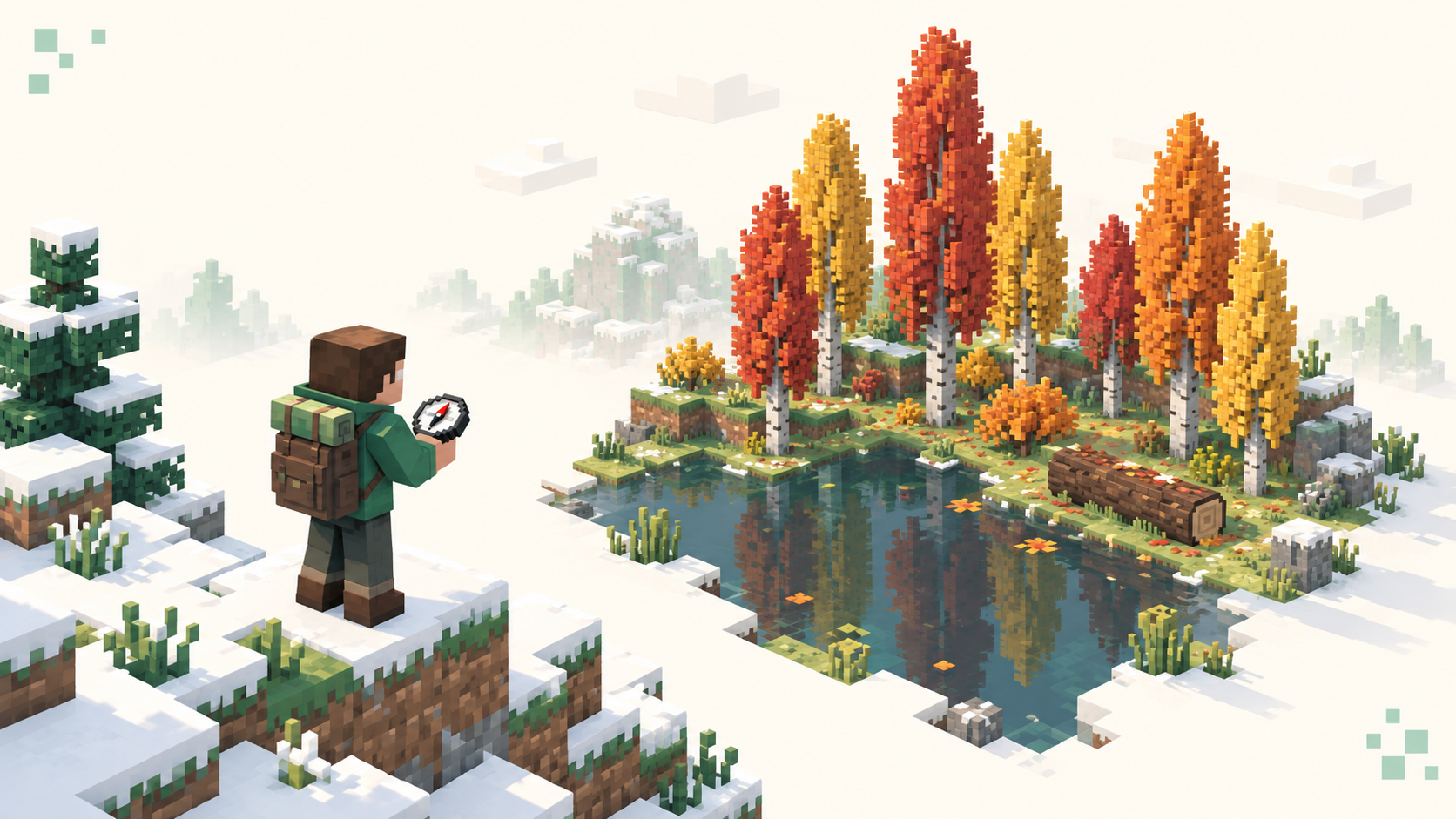
The quickest way to find a dappled forest is /locate biome minecraft:dappled_forest, which gives you the coordinates of the nearest one as long as you're allowed to use commands. Without commands, head for cold country: Mojang's own description says the biome turns up near cold biomes, and once you're close, the red, orange and yellow canopy is hard to miss. It's the headline biome in 26.3 "Wilderness Bound", released on September 15, 2026, and the full rundown of what's new in 26.3 covers the rest of the drop.
Unlike last drop's Sulfur Caves, which mostly stay underground, this is a surface forest you can see from a long way off. Just bear in mind that it only generates in fresh terrain, which matters a lot on older worlds and servers.
The fastest route: /locate
If commands are on, type this in chat:
/locate biome minecraft:dappled_forest
Chat answers with the coordinates of the nearest dappled forest and how far away it is. In Java the coordinates are clickable, and clicking them puts a /tp @s <x> <y> <z> command in your chat box, so you can teleport straight there or note the numbers and travel. That y is the height the game checked the biome at, usually the height you ran the command from, not the ground at the destination, so a teleport can leave you in the air or partway into a hill. The search reaches roughly 6,400 blocks out in each direction, so if it comes back empty, travel a good distance and try again.
In singleplayer the world needs commands allowed; if it doesn't, press Esc, open World Options and turn on Allow Commands (Hardcore worlds can't). On a multiplayer server, /locate needs permission level 2, which in practice means being an operator (see how opping works if it's your own server). Public servers almost never hand that to players, so there you'll be using the survival route below.
Older worlds have a catch. /locate works out where the biome would generate under the current world generator rather than reading your saved chunks, so it can point you at land you explored before the update, where the old biome is still sitting. If the coordinates land somewhere familiar, travel out past the edge of your explored map and run the command again from there.
Where it generates if you're exploring on foot
Mojang's changelog only says the dappled forest can be found near cold biomes. The Minecraft Wiki is more specific: it describes the biome as generating in cold, dry parts of the world, bordering plains, sunflower plains, ice spikes and cherry groves, but never another woodland biome. According to the wiki it can appear on flat land near windswept gravelly hills, beside cold oceans, or in the mountains near frozen peaks, and it ranges from a handful of trees to a forest hundreds of blocks across, often cut off from neighboring plains by a river or a mountain valley.
In practice that means following the cold. Ice spikes or frozen peaks on the horizon are a good sign you're in the right region, and the plains that run up against them are worth sweeping. Since it never borders other forests, wandering through ordinary woods and taigas is a slow way to look.
How to recognize it
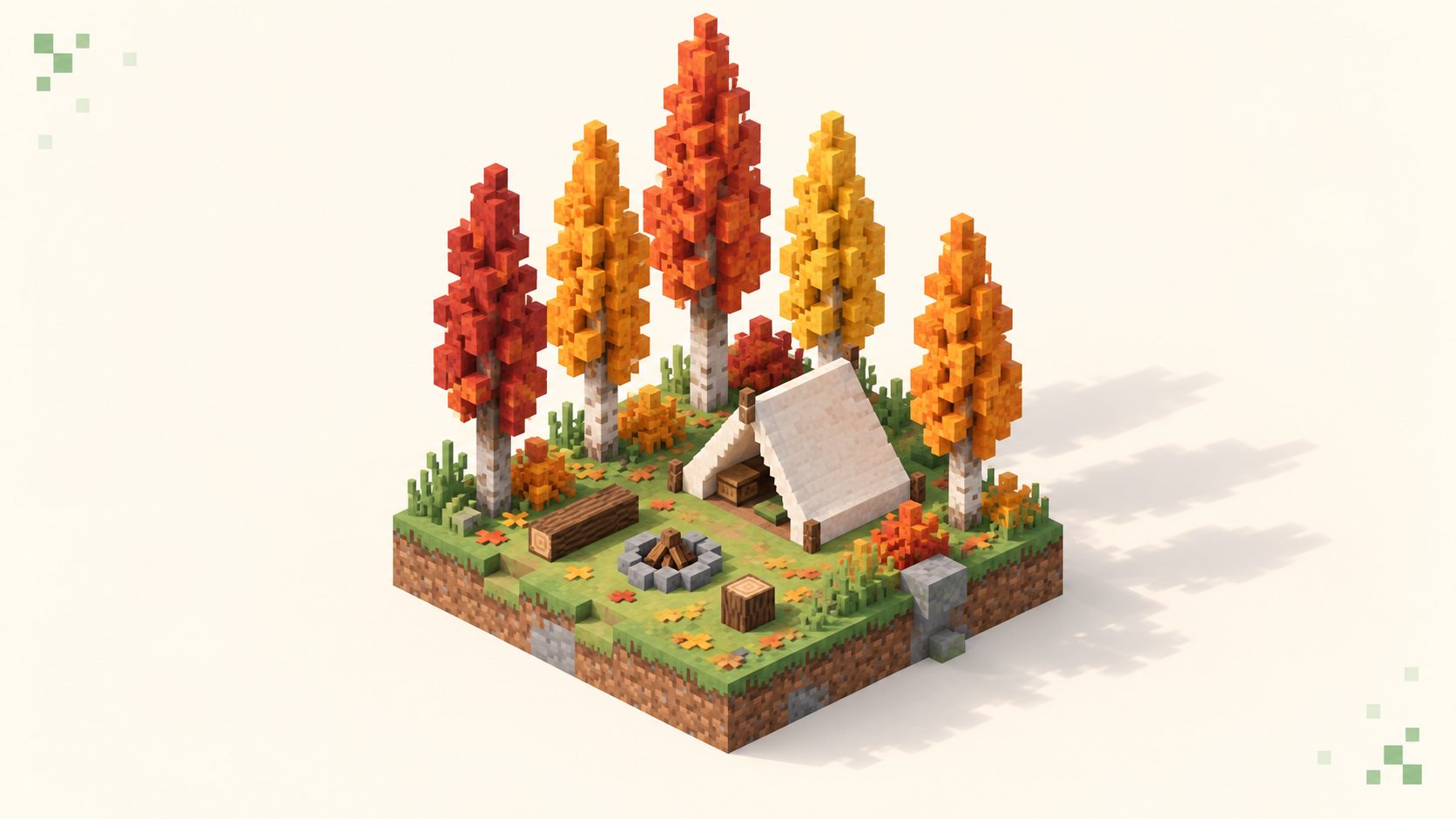
You'll usually spot the color first. Poplar trees come in red, orange and yellow. If you want a picture of what you're after, the new main menu panorama in 26.3 is a dappled forest with an abandoned camp in it.
Up close there are a few more tells:
- The grass is a saturated orange instead of green, and the short grass matches it.
- The water is very dark; the wiki calls it almost black.
- Fallen poplars are everywhere, because they generate more often than other fallen trees.
- The ground is covered in leaf litter, coarse dirt and brown mushrooms, with the odd spruce tree mixed in.
- Poplar leaves drop falling-leaf particles in their own color.
To be sure, check the debug screen. The biome line is off in F3's default layout, so press F3 + F6 to open Debug Options and switch the biome entry on. F3 then shows the biome you're standing in, and you're looking for minecraft:dappled_forest. Servers that turn on reduced debug info hide that line.
Older worlds and servers: new chunks only
Dappled forests and abandoned camps only generate in chunks that haven't been generated yet. Existing terrain isn't rewritten, so a world you've played since 26.2 won't sprout one in land you've already explored, and you'll have to travel into chunks you've never loaded. Mojang's changelog doesn't say so directly, but a chunk's biome is saved with it when the chunk is first generated.
On a server there are two more things to check. First, the server has to be running 26.3, because a 26.2 world doesn't generate the biome at all. You can browse servers already on 26.3, and trust the version on the listing over the fact that your 26.3 client connected, since some servers run ViaVersion to let newer clients join an older version. If the update has left you unable to join a server you normally play on, this guide to connection problems after 26.3 goes through the usual causes.
Second, a lot of servers limit or pre-generate their world. If a server has a world border and generated everything inside it before updating, there's no fresh terrain left for a dappled forest to appear in, and walking won't change that. Ask the staff whether they plan to expand the border or reset the map.
What to collect
Poplar saplings
Break poplar leaves and you'll occasionally get a poplar sapling (the wiki puts it at the usual 5% leaf drop). All three leaf colors drop the same sapling, and Mojang says a sapling grows into any of the three colors at random, so there's no need to hunt for red leaves in particular. The wiki adds that a sapling needs light level 9 or higher and clear space above it.
Shelf mushrooms
These grow on the sides of both standing and fallen poplars and come in a small and a large size. Bone meal turns a small one into a large one, and a large one drops two when broken, so it's worth hitting the small ones with bone meal before you pick them. They count as mushrooms in recipes now: mushroom stew and suspicious stew take any two mushrooms, and there's a rabbit stew recipe that uses a shelf mushroom. They also give a slight bounce when you land on them, a bit like a bed.
Red shrubs
Red shrubs grow in small patches on the forest floor. They stay red in any biome because they aren't biome-tinted, and bone meal spreads them, growing another shrub in an adjacent space if there's room. One shrub is enough to start a patch back home. They can go in a composter, though the wiki says they can't be put in a flower pot.
Abandoned camps
Abandoned camps generate across 18 biomes, each with its own design, and the dappled forest has its own version, which the wiki says usually comes with a poplar tree. A camp is a tent made mostly of white wool stairs, with straw beds, an unlit campfire, and chests and barrels holding early-game gear like copper armor and weapons, a spyglass or a bow.
Take the straw beds with you. A straw bed lets you sleep through the night without setting your spawn point and is used up after one sleep, which suits a long trip well. Don't try one in the Nether or the End, where it's destroyed when you try to sleep.
With commands, /locate structure minecraft:abandoned_camp_dappled_forest finds this biome's camp specifically, which also leads you into a dappled forest, and /locate structure #minecraft:abandoned_camp finds the nearest camp of any kind.
Without commands, camps can still point you here. A camp chest can contain a map to a camp in another biome, and the Dappled Forest Camp Map is one of eight types. A chest never gives a map to its own biome's camp type, so looting camps elsewhere (in a taiga, for example) can turn up a map that leads to a dappled forest. It's luck, but it beats wandering.
Animals and Adventuring Time
The passive mobs here are sheep, pigs, chickens, cows, rabbits and foxes, and the farm animals use their cold variants where they have one, so expect cold pigs, cows and chickens. The game's spawn list for the biome has no wolves, which is worth knowing if you were hoping to tame one on the way.
If you're working on Adventuring Time, the biome-visiting advancement now requires the dappled forest too, so add it to your list.
FAQ
Is the dappled forest in Bedrock Edition too?
Yes. Bedrock got it in version 26.50, which came out the same day as Java 26.3; Bedrock numbers its versions separately, so there's no Bedrock "26.3" to look for. The wiki says trees grow much more densely in the Bedrock version of the biome, enough that hostile mobs can sometimes spawn in the shade during the day.
Can I grow a specific color of poplar?
Not from a sapling, since the color is picked at random as it grows. If you want one color for a build, collect the leaves themselves with shears or a Silk Touch tool. According to the wiki, poplar leaves have fixed colors rather than biome tints, so unlike oak leaves they look the same wherever you place them.
Do shelf mushrooms stop fall damage?
No. Mojang calls them slightly bouncy, similar to beds. According to the wiki you bounce back with 75% of your landing speed but still take a little under half the normal fall damage, so don't count on one to save you from a long drop.
Can I get poplar without finding the biome?
Sometimes. Wandering traders can offer poplar saplings for 5 emeralds each, 8 poplar logs for 1 emerald, and 3 shelf mushrooms for 1 emerald. Each trader only carries a random selection of trades, though, so it isn't something to count on.