Best Earth SMP Servers for Geopolitics
How to pick an Earth SMP for geopolitics: judging map scale and authenticity, claim and war rules, alliances, regional population, and how raiding is moderated.
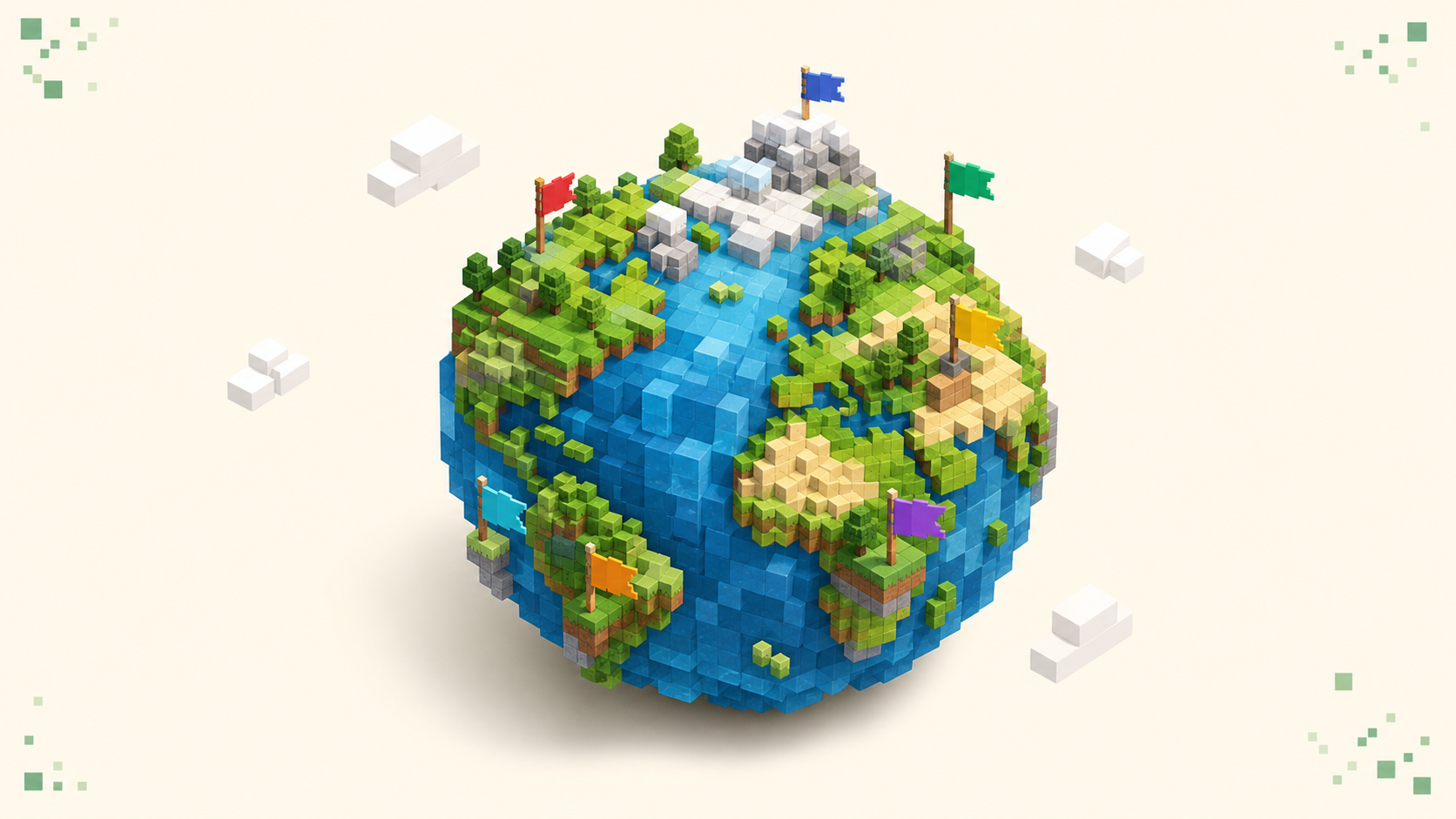
An Earth SMP for geopolitics is a Towny-style server played out on a scaled recreation of the real planet, and the thing you're actually judging when you shortlist one isn't whether the plugin works. It's whether the server's geography, claim rules, and diplomacy hold up well enough to support real nation-building and war. Two servers can run the same software and feel completely different depending on map scale, how borders change hands, and which regions have anyone living in them.
Read those rules before you move a group in. That tells you more than any ranking does. When you're ready to go shopping, the live monthly picks are the Earth SMP rankings, and that's where the current standings live. You need to own Minecraft to join one, and the large majority of Earth servers run on Java Edition (default port 25565), so assume Java unless a listing says otherwise.
What makes an Earth SMP different from a generic Towny server
Underneath, it's the same structure as ordinary Towny: the Resident-Town-Nation hierarchy, the 16x16 townblock grid for claims and permissions, the same daily bookkeeping. If you've played the Towny category before, none of that machinery will surprise you. What changes is the world it runs on. Instead of a random seed, you're on a shrunk copy of Earth with recognizable continents, coastlines, and country borders.
That fixed geography is the whole point. Real chokepoints like straits and mountain ranges actually matter, and resources and biomes are spread unevenly across the map, so the trade route between two regions can be worth as much to a nation as its army. You're still in an SMP at heart, and if the term itself is new to you the basics of what an SMP is carry over here. But the social layer is openly geopolitical. People aren't just sharing a survival world, they're drawing borders and signing treaties, fighting over land that maps onto somewhere real.
One practical note on finding these: directories rarely have a dedicated "earth" filter, so an Earth server almost always lives under the SMP and Towny tags. You shortlist from those two categories rather than searching for the word.
Map scale and authenticity: judge this first
Scale is the first thing to check because it sets the pace of the entire server. Earth maps are commonly built somewhere between roughly 1:500 and 1:2000, meaning one block stands in for about 500 to 2000 real meters. A true 1:1 Earth is far too large to run as a shared world, so admins shrink it down while keeping the continents and borders recognizable.
That number tells you what kind of game you're walking into. A smaller scale, say 1:1000 to 1:2000, gives you a bigger world with room to settle almost any region you like, but overland travel between nations takes real time. A larger scale like 1:500 compresses the same planet, so neighbors are close and conflict arrives fast. Which you want depends on your group. A bigger world gives you room to build and explore and longer hauls between nations; the cramped map gets you into sieges faster. Decide which you are before you settle anywhere.
Authenticity is the other half. Better maps are rendered from real satellite height and terrain data, so your actual home region is recognizable when you fly over it, and claiming the country you live in feels like something. Weaker maps come out flat or distorted, which quietly kills that appeal. The fastest way to check both scale and quality is the live web map. Most of these servers run Dynmap or BlueMap. The web map shows every nation's claimed territory and borders, and it's free to read in a browser before you ever log in. Open it and you can see at a glance which regions are taken and which are wide open.
Claim and war rules: how borders actually change hands
This is the part that decides if you're playing a builder's diplomacy sim or a conquest grind, so find out how war works before you commit a capital that someone can come and take. Towny doesn't handle combat on its own, it's bolted on through addons, and the one most associated with geopolitical Earth servers is SiegeWar.
SiegeWar is non-destructive and war-on-demand. A siege is a multi-day King-of-the-Hill battle fought just outside a town, with the fighting hours spread across a weekend so players in different time zones can actually show up. The specifics worth knowing: a winning attacker captures the town by placing a banner, which forcibly adds it to their nation, but the land itself isn't blown up. The penalties are handled in-game rather than by leveling your builds. Nation capitals generally can't be captured at all. And a lot of configs include a "peaceful" or neutral status, where a town buys immunity from sieges in exchange for giving up national ambitions, which is a real option for a group that wants to build without being conquered.
Not every server uses this model, though, and some run always-on or more destructive war systems where land changes hands constantly. The practical question is simple: is war scheduled or always-on, and how dangerous does that make founding next to a strong neighbor. For a deeper breakdown of the claim and combat differences, the comparison in Towny vs Factions for large communities lays out the same tradeoffs at the genre level.
There's a quieter way to lose territory, too. Towny charges daily upkeep that's auto-withdrawn from the town or nation bank, and if the bank runs dry on a day a bill is due, or the mayor goes inactive past the server's threshold, the claims get released back to the open map. On a persistent geopolitical world, that freed land doesn't sit empty long.
Alliances, diplomacy, and meganations
Nations start neutral and can be set as ally or enemy. Allies get friendly-fire protection and can join each other's wars, and that treaty layer is how a small nation buys safety instead of fighting for every inch of it. It's worth knowing the mechanics before you assume a verbal agreement means anything to the server.
Earth servers scale this up in a way plain Towny rarely does, through meganations and alliances, which are coalitions of several independently ruled nations pooling their goals. That's how a map ends up with a few recognizable power blocs instead of dozens of isolated towns. The catch to check: on a lot of Earth servers, meganation and alliance membership is tracked off-server, in community Discords, stats bots, and map browser extensions, rather than fully enforced in-game. So part of your homework is asking how much of the diplomacy is mechanical and how much is social trust.
The takeaway when you're comparing servers is whether the diplomacy has teeth. The real test is whether allies and enemies are actually enforced, and whether there's still room to form a bloc — or the map's already carved up before you arrive.
Population spread: which regions are actually alive
Earth maps have a problem random worlds don't. Players cluster in a few real regions, usually Europe and North America, while whole continents sit empty. Total player count barely matters here. What matters is whether the region you want is actually alive — a 200-player server does you no good if everyone's on the far side of the map.
This is why spawn and settlement mechanics matter so much. Where new players drop in, and whether you can found freely in an empty region versus having to contest claimed land near the active core, decides whether your group gets a foothold or spends its first week homeless. The thing to watch out for is a hegemon: a single dominant nation or meganation that already controls a continent and most of the staff's attention. Joining late into that is vassalage or constant siege with no real path to independence, which is the opposite of what a geopolitics group is there for.
The scouting method is the same one from before. Open the live map at the hours you usually play, read the ratio of claimed to open land in your target region, and count how many distinct nations are actually there. Use the monthly vote count only as a rough liveness proxy. The same population-balance thinking applies to ordinary Towny, and the sibling guide on the best Towny servers for building a nation walks through it for non-Earth maps if you want it spelled out.
Moderation: telling legitimate raiding apart from griefing
On an Earth server the governance line is specific. War is supposed to be allowed, sieges, occupation, plunder under the rules, while griefing outside claims and plain rule-breaking are not. So ask how staff draw that line, and whether the war rules are published clearly and actually enforced. A server that can't tell a sanctioned siege from random destruction will turn every nation conflict into a mess no one wants to be part of.
A few concrete things to look for. Rollback and logging, the CoreProtect kind, so a betrayal or an out-of-bounds grief can be undone instead of just argued about. Visibly active moderation rather than vague rules nobody applies. Anti-cheat quality matters more than usual here, because sieges come down to combat and one unchecked hacker can swing a weekend-long battle and the territory riding on it. Uptime is non-negotiable for something you're investing months into, so find the server's reset or season policy before you commit to building a nation that might get wiped. Ping matters less for diplomacy than for twitch PvP, but war is still combat, so favor a server hosted near your group.
Shortlisting with the live rankings
Put the scorecard together and you're looking for a map scale and authenticity you like, claim and war rules your group can actually sustain, real depth in the alliance and diplomacy systems, a target region that's alive without a single hegemon sitting on it, and the basics covered: rollback-backed moderation, solid uptime, acceptable ping.
Do the actual shopping on the live, monthly-resetting Earth SMP rankings, cross-referenced with the Towny category. The homepage resets every calendar month, so the top of the list reflects who's active right now rather than who was big a year ago. Then scout two or three candidates on their live maps, found a throwaway solo town for a few days to feel out the upkeep math and see how fast staff answer a real ticket, and only move the whole group once the geography and the community both line up.
FAQ
Can I play an Earth geopolitics server on Bedrock or console?
Usually only through the back door. Most Earth servers are Java-only, so a Bedrock or console player needs the server to be running Geyser and Floodgate, which lets a Bedrock client connect to a Java server. Plenty of large Towny and Earth servers do run it, but it isn't universal, so check the listing for a Bedrock IP and port (Bedrock's default is 19132) before you assume you can get in. If a server is Java-only with no bridge, a console player can't join at all, since consoles can't run the Java client. The Geyser and Floodgate explainer covers what the bridge carries over and what it doesn't.
Do Earth SMPs use Towny or custom plugins for nations and war?
Almost all of them build on Towny for the core Resident-Town-Nation hierarchy and land claiming, then layer addons on top for the geopolitical part. The war system is what varies most. SiegeWar is the addon most associated with these servers, running non-destructive, scheduled sieges where towns can be captured but not destroyed, while other servers run Event War or Flag War with different rules about when and how land changes hands. Because the war addon defines the entire risk profile of nation-building, find out which one a server uses, and whether war is always-on or scheduled, before you settle anywhere important.
Can my group realistically claim a whole real country on these servers?
Sometimes, and it comes down to scale plus who's already there. On a larger-scale map a real country might be only a handful of townblocks, so a small active group can hold it, while on a smaller-scale map the same country is enormous and needs real numbers to claim and defend. The bigger constraint is occupancy. Popular regions are usually carved up by established nations or a dominant meganation, so taking the area means contesting claims through the war system rather than founding into empty land. Picking a quieter but still-active region is often the faster route to actually governing territory than fighting for a crowded one.
What happens to my nation's territory if we stop playing for a while?
You lose it faster than you'd think, and the fix is to prepare before the break rather than after. Top up the town and nation bank well past a single day's upkeep so a missed login doesn't bankrupt you. Then find the server's mayor-inactivity threshold, usually a set number of days written into the rules or pinned in the Discord, and hand the mayor role to whoever's most likely to log in during the gap, since an inactive mayor can drop a town even with a full bank. On a contested map, neighbors re-claim freed land within days, so a quick heads-up to an ally who can hold or re-found your claims is worth more than any amount of stockpiled resources.