What Is an SMP in Minecraft?
SMP means Survival Multiplayer — a shared, persistent Survival world built around a regular group of players who cooperate instead of competing.
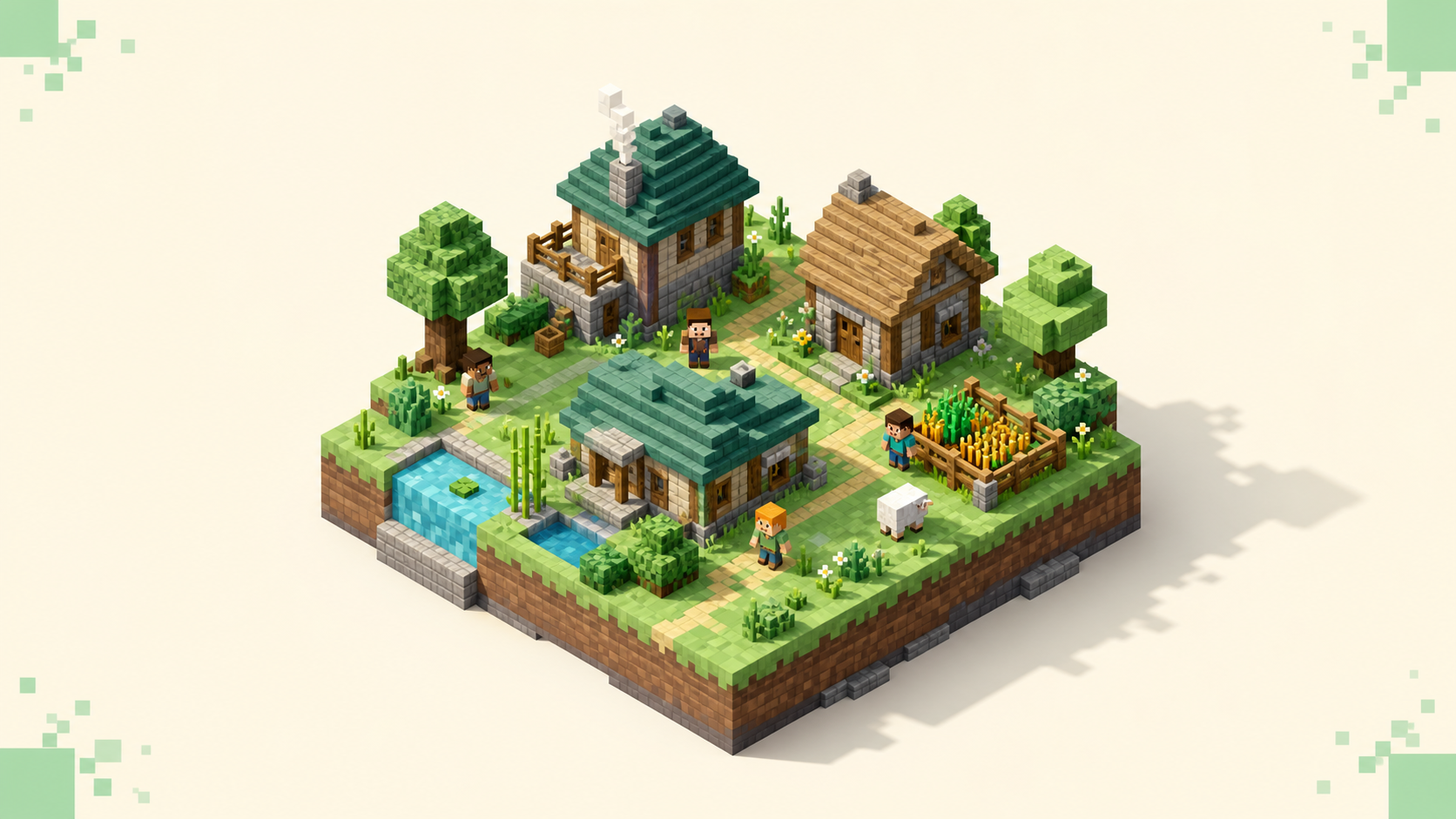
SMP stands for Survival Multiplayer: a single Survival-mode world, shared by a recurring group of players, that keeps running and keeps your progress between sessions. You're playing normal Survival — health and hunger, hostile mobs, gathering wood before you can build, no free creative-mode items — except other people are doing it in the same world, and over time that turns into a community with regulars, trades, and the occasional bit of drama. If you came here from Minecraft server types explained wanting the long version of the Survival entry, this is it, and the live SMP servers list is where you'd go to actually join one.
The part people miss is that "SMP" isn't a setting you switch on. There's no smp=true anywhere in the config. It's a label the community uses for a particular kind of Survival server — cooperative, social, built to last — and what makes a server an SMP is intent and setup, not a single toggle.
What actually makes a server an SMP
Three things have to line up. Drop any one of them and you've got something else.
- Survival is the core loop. The gamemode is
survival, with all the friction that implies. You mine your own diamonds, you fight your way through the night, you lose your stuff if you die badly. That grind is the point, not an obstacle to skip. - It's multiplayer and persistent. Same world, same people, week after week. The base you built in March is still standing in July, and so is the one your neighbor built next door. Progress carries over, which is what lets anything bigger than a single play session form.
- There's a social layer. Regulars who recognize each other, shared projects, informal trade, the odd alliance or running joke. This is the bit that separates an SMP from "a Survival server with strangers passing through."
The first two are mechanical and easy to spot; the third gives the format its character, and it's why two servers running identical settings can feel completely different.
Where the term came from
"SMP" goes back to Minecraft's early days, roughly 2009 into 2010, when Notch first started testing multiplayer for the new Survival mode. Creative multiplayer already existed, so people needed a way to say "the survival kind" — and Survival Multiplayer, shortened to SMP, was it. The acronym outlived the problem it solved: almost nobody runs creative multiplayer servers now, but the label stuck.
What pushed it into everyday use was creators. Mindcrack got going around 2010, Hermitcraft followed in 2012, and the format went genuinely mainstream during the 2020 lockdowns with the Dream SMP. That lineage is where phrases like "creator SMP" and "SMP season" come from. These dates are the widely-accepted community history, not anything Mojang put on record — but the shape is right: a private group sharing one Survival world, with the story of that world as the draw.
The two spectrums every SMP sits on
Once you know what an SMP is, the differences between them mostly come down to two questions.
Private or public
Private SMPs run a whitelist, so only approved players can connect. That's the standard mechanism — friend groups and tight-knit communities use it to keep the world to people they actually know. Public SMPs are open to anyone, sometimes gated behind an application or backed by claim protection and active moderation so that "open" doesn't mean "free-for-all." Most of what you'll find on an SMP directory is public or application-based, since a purely private friends' world isn't usually advertised.
Vanilla or semi-vanilla
Pure vanilla means unmodified Mojang server software — no plugins, nothing between you and the game as shipped, and no safety net if someone decides to grief. Semi-vanilla swaps in something like Paper or Spigot and adds a handful of quality-of-life or protection plugins — land claims, anti-grief and rollback, /sethome, crossplay, light moderation tools — without touching the core survival loop. It still feels vanilla to play; it just has a few rails so one bad actor can't torch the place. There's no fixed plugin list that makes a server "semi-vanilla"; it's a spectrum and a judgment call. If you specifically want the protected end of it, survival servers built for small groups with no griefing is a good starting point.
SMP vs anarchy vs factions
These three get lumped together because they're all Survival underneath, but the intent behind each is different, and that's what matters when you pick one.
Anarchy is the opposite of an SMP. No rules, no protections, no whitelist — griefing, stealing, and hacked clients are all fair game by design. The chaos is the entertainment. An SMP has at least some rules or moderation and is built around people not burning each other's bases down. If unfiltered lawlessness is what you're after, that's an anarchy server, not an SMP.
Factions is competition with a structure bolted on. It runs on the Factions plugin: organized teams, land claimed through faction power, raiding and war as the actual gameplay. The PvP is the content. On an SMP, competition is incidental — players might compete over a good mining spot, but the server isn't built to pit them against each other. PvP on an SMP is a server choice, and plenty run it off or opt-in so the world stays cooperative. If you want the warfare version, factions is its own thing.
The clean way to hold all three in your head: SMP is cooperation first, anarchy is chaos first, factions is competition first. Same gamemode, three different reasons to log in.
How whitelisting actually works
The whitelist is what makes a private SMP private, and it doesn't behave quite like "on means locked." On a Java server, owners manage it with /whitelist add <name> and /whitelist remove <name> (the player doesn't need to be online — entries are stored by UUID), /whitelist list to see who's approved, and /whitelist on / /whitelist off to flip it. Anyone who isn't on the list gets bounced with You are not white-listed on this server!. Bedrock calls the same thing an allowlist: /allowlist add <name>.
The catch most owners hit: turning the whitelist on only blocks new connections. Anyone already in the world stays until they disconnect. If you want online players who aren't on the list booted immediately, you need enforce-whitelist=true in server.properties, which kicks them when the whitelist file is reloaded. And operators always get in regardless — an op can connect even with the whitelist on and their name not listed.
FAQ
Does an SMP have to be vanilla?
No. The vast majority of public ones are semi-vanilla — Paper or Spigot plus claims, anti-grief, and a few quality-of-life commands — and that's not a downgrade, since the survival loop stays intact and the plugins mostly exist to stop griefers rather than hand you free gear. You connect with the normal game client either way; those plugins run entirely on the server, so there's nothing to install on your end. The exception is a modded SMP, which expects you to load a specific modpack first. Pure vanilla is the purist's choice, but semi-vanilla still counts as an SMP.
What's the difference between an SMP and a normal survival server?
Mostly the social layer and the expectation of permanence. Every SMP is a survival server, but not every survival server is an SMP — a big public survival server full of strangers cycling through isn't really one. The SMP label implies a recurring group, a world that's meant to last, and a culture of cooperation rather than just "Survival mode is enabled."
Where is the whitelist actually stored?
In whitelist.json on Java (or allowlist.json on Bedrock), sitting in the server root right next to server.properties. Each entry holds a player's UUID and name, and you can add people offline by editing the file directly — just run /whitelist reload afterward so the server picks up the change, since it won't notice a hand-edited file on its own.
Can a hardcore SMP exist?
Yes, and they're popular among groups that want real stakes. Setting hardcore=true on the world means death is permanent — one bad fall and you're a spectator for the rest of the season. It's a flavor of SMP rather than a separate genre, the same way "modded SMP" and "creator SMP" are. If permadeath sounds like your group's idea of fun, the hardcore list collects servers built around it.
How do I find a good SMP to join?
Start with the SMP servers list, which is ordered by votes earned this month, so the servers near the top are the ones people are actively playing right now. Check whether it's whitelisted or open before you get attached, look at the stated version so your client matches (Java is on port 25565 by default), and read the rules — an SMP's rules tell you more about its community than its spawn build does.