Towny vs Factions: Which Is Better for Large Communities?
A practical Towny vs Factions comparison for big groups: land-claim mechanics, griefing exposure, and admin overhead, with concrete tradeoffs for each.
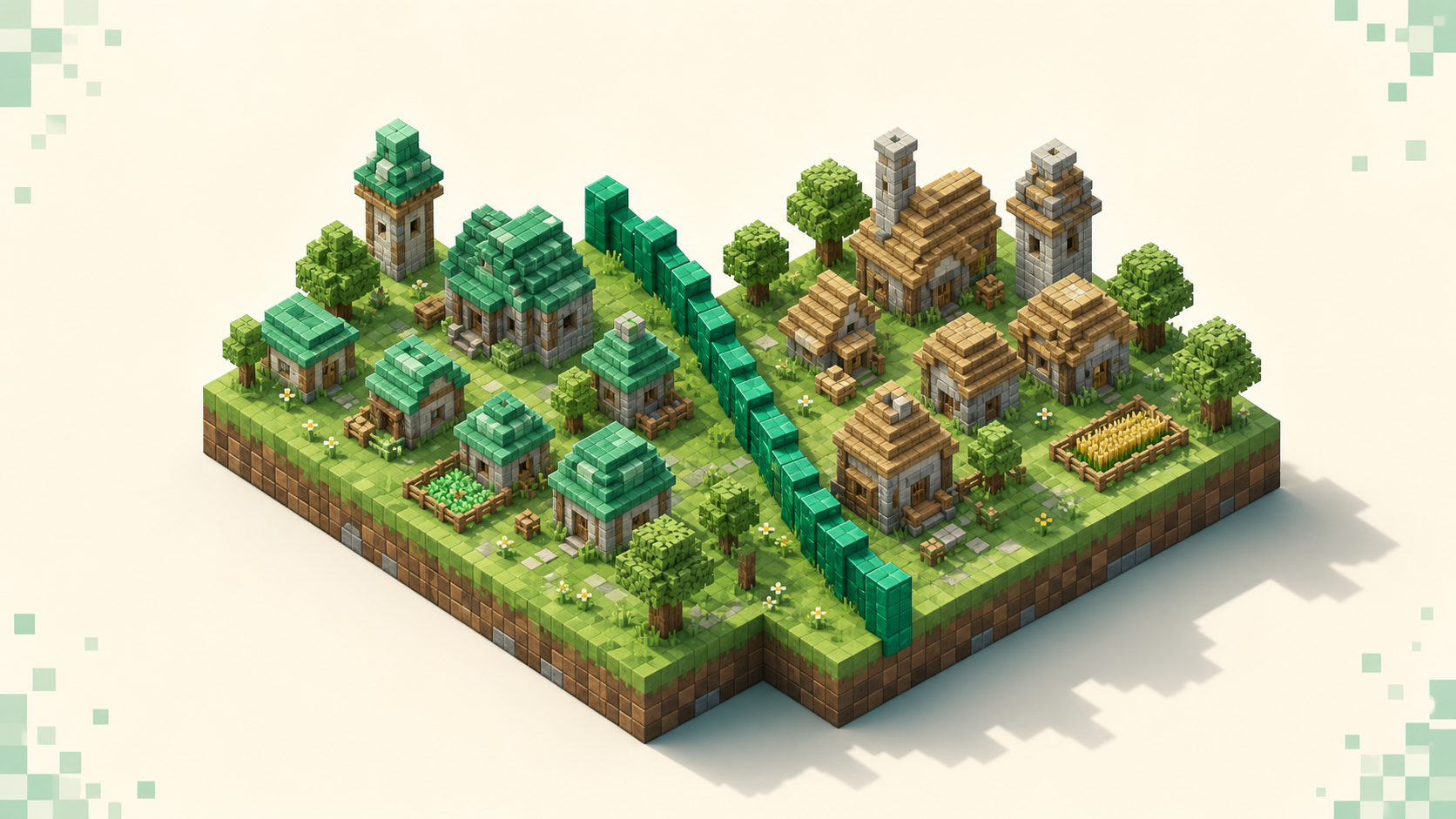
The choice comes down to one thing: do you want your community's borders to be fought over, or to stay put. Factions is built around contestable territory — claims can be taken by force — while Towny is built around durable, permission-locked land and long-term politics. Both are chunk-based systems running on the same 16x16 grid, so the unit of land is identical; the difference is entirely in the rules layered on top. Once a community grows past a handful of friends into dozens or hundreds of players with their own agendas, that one difference decides whether your map holds together or constantly churns. Below I'll walk through how each one claims land, how exposed your builds are to griefing and raiding, and how much work each puts on your staff.
How each system claims land
Towny starts every world as Wilderness, where anyone can build. A player founds a town, the founding chunk becomes the homeblock, and from there they claim adjacent townblocks outward. How much land a town can hold is governed by a configurable townblocks-per-resident ratio, so a town's footprint scales with its population — more residents, more claimable chunks. Land that isn't adjacent to the town needs an outpost (/t claim outpost), which costs more and generally requires the town to belong to a nation. Towns themselves group into nations for shared identity, allies, and bonuses, and that nation layer is the structure that lets large, federated communities exist under one banner.
Factions handles the same problem differently. Every player carries individual "power," and a faction's total power is the sum of its members' power. Each point of power allows roughly one chunk of claim, so a 10-member faction with 10 power each can hold around 100 chunks. The catch is that power is dynamic — it drops when you die and regenerates over time — so a faction's maximum claimable land rises and falls with how its members are doing in PvP. Recruiting more people raises the ceiling, but it also adds power that enemies can bleed away in fights.
That's the concrete tradeoff for a big group. Towny land is allocated and stable: claim it once and keep it. Factions land is a live resource pool that shrinks when the group is losing, so a faction is always managing the gap between how much land it holds and how much power is keeping that land safe right now. If your organizers are still deciding which broad gamemode fits the group at all, the server types breakdown sorts that out before you get into plugin specifics.
Both the townblocks-per-resident ratio and the power-per-claim rate are server-configurable, so treat the numbers above as common defaults rather than hard universal values.
Griefing exposure and how borders are defended
In Towny's normal peacetime model, claimed townblocks are protected by permission flags, and that's where your grief protection comes from. Each townblock has build, destroy, switch, and itemuse toggles set separately for residents, allies, and outsiders (/t set perm ...), and the standard advice is to turn off build and destroy for outsiders. Do that and, outside of an explicit war, a town's interior is effectively grief-proof by default — outsiders simply can't touch blocks they don't have permission for.
PvP inside a town is a separate setting, and it's worth getting right because people assume otherwise: town PvP is server-configurable and toggled per town with /t toggle pvp, so it can be on or off depending on how the server and the mayor set it. Wilderness PvP, on the other hand, is permanently on. So "Towny means no PvP" is wrong — what's reliably true is that town land is protected from building by outsiders, not that fighting is disabled everywhere.
When Towny land does change hands, it happens through an opt-in war system, not constant attrition. Separate systems — Event War, Flag War, and Siege War — each define when and how territory can be contested. In some war modes a townblock has "health" that drops as enemies occupy the plot, until the claim is finally lost, and admins can schedule armistice or peace periods around all of it. Destruction is scheduled and bounded rather than always-on.
Factions is the opposite by design. Raiding is the core loop, and your only real protection is the land you can currently hold. When a faction's power drops below its number of claimed chunks, enemies can overclaim those chunks directly with /f claim and gain edit rights to them — they take the territory by lowering your power in combat, not by cannoning through every wall. To be precise about it: overclaiming only works when power is below the claim count, so it's a different thing from ordinary claiming, and it's the whole point of the raid loop. You kill the enemy to lower their power, then take their land.
For a large community, that mechanic sorts who you can keep. A big Towny server can host builders, roleplayers, and economy players who never want their work touched, and the permission system actually delivers that. A big Factions server thrives on rivalry, but it will shed casual and builder players who hate losing progress, because losing progress is the game. Match the mechanic to who you're recruiting — the people who love one of these will quietly leave the other.
Admin overhead and day-to-day moderation
Towny offloads a lot of governance onto player leadership. Mayors run their own towns and nation leaders run their nations — managing residents, plots, and permissions themselves — which is genuinely useful at scale because every town is a little self-moderating unit. The cost is up front: the permission, plot, and nation systems are deep, so your staff field more "how do I claim this" and "how do outposts work" questions, and you'll spend real time configuring ratios, war rules, and upkeep behavior before launch. Towny is the more complex, more configurable plugin, which means more setup but less moment-to-moment firefighting once communities self-organize.
Factions is simpler conceptually — power leads to claims leads to raids — but it generates far more live conflict. Raid disputes, accusations of cheating mid-raid, and griefing complaints that are technically working as intended all land on your staff anyway, and at a few hundred players that's a steady stream of tickets. Anti-cheat quality matters more here than almost anywhere, because combat is the entire game and one unchecked hacker ruins the experience for everyone in a fight. So the overhead doesn't disappear with the simpler model; it just moves from configuration to conflict response.
One thing worth flagging for experienced admins before you commit a large group: most current Factions servers don't run the original plugin but a long-lived modern fork (FactionsUUID is the well-known one), so check that whatever plugin or fork you pick is actively maintained and updated for your server version rather than assuming the project you remember is current.
And don't pick based on imagined resource cost. Both are lightweight protection plugins. A large community's RAM and performance ceiling is driven far more by raw player count, world size, and the rest of your plugin stack than by the choice between these two, so the Towny-vs-Factions decision is about social design, not server load.
Choosing for a large community: a decision framework
Pick Factions if the community's identity is competition — organized PvP, base-building for defense, raiding rivalries, and a player base that accepts losing land as part of the fun. The people who enjoy that will keep showing up precisely because the stakes are real. You can see which Factions communities are active right now on the live Factions listings.
Pick Towny if the identity is settlement and politics — persistent cities, plot ownership, economy and roleplay, nations and diplomacy, and builders whose work has to survive. The whole appeal is permanence and the social structure built on top of it, and the Towny listings show which communities are running that well.
The honest answer for a lot of large servers is somewhere between the two. Plenty run Towny with an opt-in war system to get persistence plus periodic conflict, or run Factions with strict raid rules to soften the churn. So "which is better" often resolves to "which default do you want, and how much are you willing to override it." Decide the base feeling first, then bolt on the exceptions.
Whatever you land on, judge the actual candidate communities the way you'd judge any server: active population, uptime, visible staff and moderation, real anti-cheat, and ping to your region. A dead Towny server and a dead Factions server both fail regardless of which mechanics they chose. The way to see which communities are genuinely alive is the monthly vote rankings on the homepage and the full server list — both reflect current activity rather than a static, hand-picked roster, so you're comparing real momentum instead of marketing.
FAQ
Can a large community run Towny and Factions at the same time?
Not meaningfully on one world. Both want to own the land-claim layer and define conflicting rules for who can build where, so running them together usually causes permission collisions. Communities that want both feelings typically run them on separate worlds or separate servers — for example a persistent Towny world alongside a dedicated Factions raiding world — or they pick one base plugin and bolt an opt-in war or raid addon onto it rather than stacking two full claim systems on top of each other.
If our group migrates from Factions to Towny, does land transfer over?
No. The two plugins store claims and membership in completely different ways — Factions tracks power-based faction claims, while Towny tracks townblocks, residents, and nations — so there's no clean automatic conversion between them. A migration means re-claiming and re-permissioning everything under the new system, so plan it as a fresh map or a staged rebuild rather than an in-place swap, and warn members ahead of time that their existing territory won't carry across.
In Factions, what actually happens to a big faction's land when it's losing badly?
Because power drops on every death, a faction that keeps dying watches its total power fall below its claim count, which flips its territory to raidable. At that point enemies use /f claim to overclaim chunks directly and gain edit rights — no wall-breaking required. For a large faction this can cascade fast: more deaths means less power means more lost chunks, so the practical defense is keeping members alive and power high, not just building thicker walls.
How many staff do I need to moderate a busy Factions server?
There's no exact formula, but a useful starting point is one active staff member online per roughly 50 to 75 concurrent players during your peak hours, weighted toward the times raids actually happen. Factions tickets cluster around combat, so coverage matters more than raw headcount — three people spread across the day beats six who are all online at noon and gone by the evening raid window. Towny tolerates thinner live coverage once towns self-organize, since most of its governance runs through mayors rather than through your staff.