Best Prop Hunt Servers: How to Choose
Prop hunt servers: how to judge map variety, anti-camp taunts and glow, round pacing, lobby size, and ping before you pick a hide-as-a-block lobby.
The best prop hunt server is the one that fills a full round fast, rotates a deep enough map pool that hiders can't just memorize every real-prop spot, runs actual anti-camp pressure like forced taunts or periodic glow, and has staff who show up. That's not a server name, and it never will be. A frozen "best" list goes stale because these lobby populations shift month to month, so the real skill is learning to read a listing yourself and then checking the live minigames rankings, which reorder by this month's votes so the busy lobbies float to the top.
What prop hunt actually is
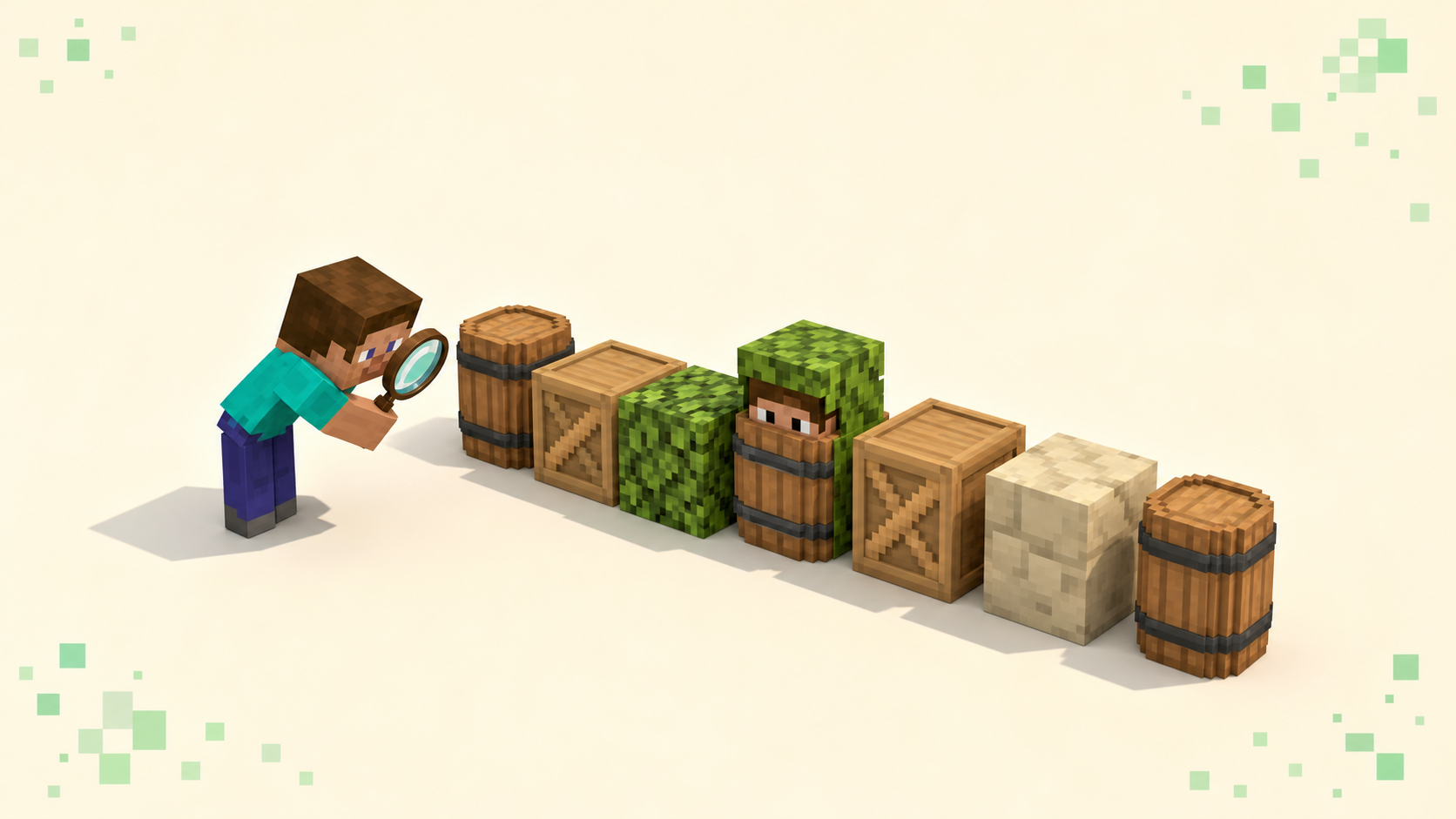
Prop hunt is the hide-as-a-block minigame. Each round splits the lobby into two teams: Hiders and Seekers. Hiders disguise as ordinary in-world objects — a crate, a barrel, a flowerpot, a stray bit of furniture — and freeze in place around the map, trying to pass as part of the scenery. Seekers spend a round timer hunting them down. Roles swap between rounds, so you spend some time frozen against a wall pretending to be a chest and some time smacking chests hoping one of them yelps.
This is a different game from plain hide-and-seek, and the difference matters when you're picking a server. The minigames servers for quick sessions post calls that format "Hide and Seek (sometimes called Block Hunt)," where you tuck your normal player model behind cover. In prop hunt you become an object and blend into the map's genuine props — the whole tension is that the seeker can't tell your barrel from the forty real barrels around it. And like most minigames, prop hunt has no dedicated tag on this site — you'll find these lobbies filed under /servers/minigames, and it doesn't need its own category to work. Murder mystery servers are the other lobby game people confuse with this one, and there the hiding is social rather than physical.
Map variety: memorized prop spots kill it
This is the breaker most guides skip. A good prop hunt map has a lot of real props scattered across mixed sightlines — clutter you can genuinely disappear into — plus tucked-away spots that aren't the same three corners every veteran already knows. The failure mode isn't ugly maps, it's stale ones.
When a server loops the same handful of maps forever, the game solves itself. Seekers memorize exactly where the "extra" barrel always sits, which flowerpot is a person, which corner hiders always run to. At that point it's not prop hunt anymore, it's a memory test, and the hiders lose every round because there's nowhere left that isn't already checked. What you want is a deep rotation that visibly gets added to over time rather than frozen at launch. There's an honest little tell here: if you recognize every map inside your first two sessions, the pool is too thin, and it'll feel solved within a week.
Taunts, glow, and how servers stop corner-camping
The angle that separates a well-built prop hunt server from a lazy one is what it does about hiders who just wedge into a dark corner and go AFK. A prop that never moves and never makes noise is nearly impossible to find in a cluttered map, so without countermeasures every round drags to the timer while one camper wins by doing nothing. Good servers won't allow it.
The common approaches, described generically because the exact tuning varies by server:
- Forced taunts. Every so often a hider is made to emit a sound or taunt, handing seekers an audio clue to home in on. It's the standard anti-camp pressure, and it means sitting perfectly still isn't a free win.
- Glow or map ping. Many servers make a hider briefly glow, or ping their rough position on the map, at intervals — another nudge that keeps hiders from turning invisible forever.
- A shrinking play area or border that squeezes everyone toward the middle as the round winds down, so corners stop being safe.
- Idle or last-minutes penalties — seeker damage on stationary props late in the round, or a final-stretch reveal — so the clock works against campers.
Round pacing follows from this. A server that pushes hiders to move, taunt, and occasionally light up keeps rounds tense instead of letting them stall. One with none of that plays slow and camp-y, and no map pool fixes it. Watch a round or two before you settle in — you'll feel immediately whether the server has pressure or whether everyone's just holding a corner.
One more mechanic worth knowing: seekers usually take a health or point hit for smacking the wrong (real) block, which is there to stop mindless wall-smashing where a seeker just breaks the entire map. If a server lets seekers flail at every surface with no penalty, hiding is pointless and the disguise layer collapses.
Population and queue times
Prop hunt needs a reasonably full lobby to work — roughly 8 to 16 players is the range where hiders can actually blend. With three hiders in a big map, every prop is obvious; there aren't enough of you to hide among the real clutter. With an empty queue, no round starts at all. So read the live concurrent-player count on the listing before you commit, and test it at your real play hours. A lobby packed at European peak is a ghost town on a North American weeknight.
A high spot on the minigames rankings is a decent live-population signal on its own, because votes track who's active right now rather than who was big two years ago — the mechanics of that are in how server rankings work. Use the board as a shortlist, then confirm with your own eyes at the hour you'll actually be online.
Ping, TPS, and version housekeeping
Prop hunt is forgiving on movement, but seeking and reacting to taunts is timing-ish, so ping still matters. Rough bands: under about 60ms is excellent, under 100ms is solid, past roughly 130ms you'll notice a disadvantage, and past 180ms your hits and movement start to desync. The only real fix is distance, so pick a region-local host. The Multiplayer screen's signal bars give you a live read before you even join. The country filter takes an ISO code in the path, so swap us for your own; treat that as an example to adapt.
The server side matters too. A Minecraft server targets 20 TPS, one tick every 50ms, and a lobby that can't hold that under a full load rubber-bands players and makes broken blocks reappear. TPS isn't shown directly, so judge it by feel during your test round — if a full lobby feels stuttery, that's the tell. Then confirm your client version matches what the server runs. A mismatch throws "Outdated client!" or "Outdated server!" in the disconnect screen and won't let you in. Vanilla clients are on 26.3 "Wilderness Bound," but many plugin lobbies still target 26.2, since that's Paper's stable line as of September 2026 and its 26.3 builds are still experimental, so you can filter 26.2 or 26.1 servers directly and adapt the number in the path. Plenty of servers also run ViaVersion so a range of client versions can connect even when the numbers don't line up exactly.
On the cheating side, prop hunt exploits look different from most modes — it's wallhack and no-clip that let a seeker see hiders through blocks, plus reach on the seeker's swing. It's fair to want a real anti-cheat like Grim or Vulcan running underneath; choose a server anti-cheat covers how to read that. But social and moderation quality still matter more than any detection spec — active staff and a working report system beat a long feature list.
Console and phone players reach prop hunt through Bedrock. Either you tap a Featured Server (one tap, no IP typing) or you join a crossplay Java host running Geyser and Floodgate by IP on the Bedrock port 19132 — not the Java 25565. The wrinkle is consoles: Xbox, PlayStation, and Switch have no native "Add Server" box, so a crossplay IP needs a workaround there. If that's you, start with best Bedrock minigames servers.
Red flags to skip past
- A dead or thin queue at your play hours, not at some peak you'll never be online for.
- A big max-player cap sitting next to a near-zero live count — that's "was busy years ago," not "busy now."
- Only two or three maps in rotation, and you've already got them memorized after one night.
- No taunt, glow, or shrinking-area pressure, so hiders just camp a corner and win on the clock.
- Seekers wall-smashing the whole map with no penalty for wrong hits.
- Persistent rubber-banding or blocks reappearing once the lobby actually fills up.
- High or jumpy ping in the Multiplayer signal bars before you even click join.
Using the live rankings to pick
Open the minigames rankings, which reorder by this calendar month's votes and reset when the month flips. Shortlist two or three near the top, join each, and spend ten minutes testing the four things that actually decide it: does a round fill to a healthy 8-to-16, is the map pool varied enough that you're not seeing the same loops, does the server actually push hiders out of corners with taunts and glow, and is the ping livable. Browse the full server list if you want more options, and narrow by country to keep the ping honest. When one of them clicks, vote for it — that's what keeps the board accurate for the next player deciding the same thing.
FAQ
Do you need any mods or a texture pack to play prop hunt?
No. Prop hunt runs entirely server-side, so a stock Java or Bedrock client joins the lobby and the plugin handles the disguises, taunts, and glow for you — there's nothing to install beforehand. The only thing that will actually block you is a version mismatch, which is a client-version fix, not a mod. If a server pushes a resource pack when you connect, accept it; that's cosmetic map dressing, not a requirement you set up yourself.
Why do I keep getting found right away as a hider?
Usually one of three self-inflicted things. You picked a prop that doesn't belong where you're standing — a lone barrel in the middle of an open floor reads as a person instantly, so match your disguise to nearby real clutter. You moved while a seeker had line of sight, and even a small nudge is a giveaway. Or you bunched up with other hiders in the same nook, turning it into an obvious cluster. Blend into an existing pile of the same object, hold still when eyes are on you, and drift only when the seeker's back is turned.