Best Bedwars Servers: What to Look For
How to pick a Bedwars server that actually fills lobbies — judge population, modes, maps, anti-cheat, and ping, then use the live Bedwars rankings.
The best Bedwars server is the one that fills a lobby in under a minute, because the gamemode does nothing for you while you sit in a half-empty queue. Everything else — fancy maps, a long shop, custom cosmetics — is downstream of whether enough people are online to start a round. I'm not going to hand you a list of named servers, since the answer turns over month to month and the live Bedwars rankings already show which communities are busy right now. What's worth your time is learning to read those listings for the signals that separate a Bedwars server you'll stick with from one you'll abandon after two games.
What Bedwars actually is
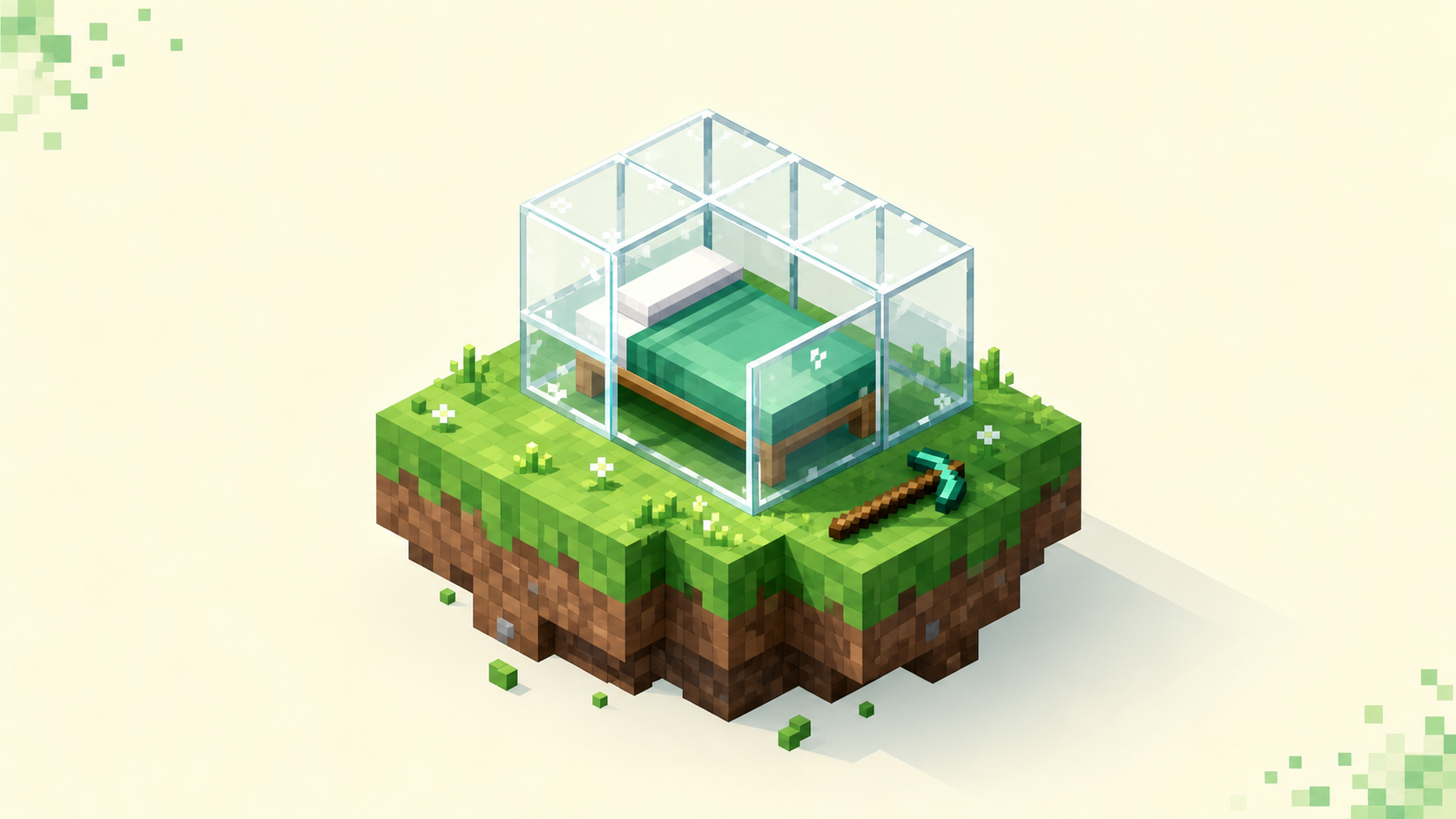
Bedwars is a team elimination minigame played on floating islands in the void. Each team spawns on its own island guarding a single bed, and as long as that bed is intact, everyone on the team respawns indefinitely when they die. Break an enemy's bed and the rule flips for them: the next kill is permanent, and a team is out once all of its players are eliminated with their bed already gone. That permanent kill is usually called a "final kill," though not every server's menu uses the phrase. The last team with a living player wins.
You buy your way to those beds with resources that pour out of generators. Four currencies matter, tiered by how fast and where they spawn:
- Iron trickles fastest, right on your own island, and pays for blocks, basic tools, and starter armor.
- Gold spawns more slowly on your island and covers intermediate items and small upgrades.
- Diamond spawns at the mid islands and funds team-wide upgrades and better gear.
- Emerald is the rarest, restricted to the central island, and buys the strongest items in the shop.
The core of the game is the tension between pushing out for diamonds and emeralds and walling your own bed in. Wool and wood go up fast but break fast; the real defense is obsidian, which shrugs off even an enchanted diamond pickaxe for several seconds and buys you time to come back and clear whoever's mining it.
Modes are mostly a question of team count. Solo and Doubles run up to eight teams on a single map, while 3v3v3v3 and 4v4v4v4 — usually just called 3s and 4s — pack four teams onto a larger map. 4v4 is a separate two-team duel on a smaller map, often with a shrinking world border to force fights. Worth knowing up front, because it changes what "fully populated" means: an eight-team doubles game needs as many as sixteen players before it starts, while a solo lobby of the same size needs eight.
What makes a Bedwars server good
Population and queue speed
This is the single best indicator, full stop. A Bedwars round won't begin until the lobby fills, so a server with a thin player base leaves you watching a countdown that keeps resetting, or drops you into a game that's half bots and half empty slots. Read the live concurrent count on each listing, and favor the servers near the top of the Bedwars rankings, since those are ordered by this month's votes and a high vote total means players keep coming back rather than spiking once and vanishing.
Modes offered
A full spread — solo, doubles, 3s, 4s, and 4v4 — gives you room to switch up how you play. But more queues split a finite pool of players across more lobbies, so on a smaller server, fewer modes that each fill quickly beats a long menu where nothing has the numbers to start. On a big network the spread is pure upside; on a quiet one it's a warning sign dressed up as a feature.
Map rotation and balance
Good Bedwars maps are symmetric. Every team should get the same generator placement, the same bridging distances to mid, and the same approaches to defend. A server that rotates through a balanced pool keeps games fresh and stops one base from being the obvious easy target every round. Lopsided or stale maps are a quiet way for a server to feel unfair without anyone hacking.
Anti-cheat and active moderation
Bedwars is melee PvP at its core, which means reach, kill-aura, fly, speed, and autoclicker hacks ruin it more directly than they would in a casual building mode — one flying player with reach can clear a defended bed that should have held. A reputable server runs a server-side anti-cheat plus staff who act on reports. A solid free option is GrimAC, an open-source (GPL-3.0-or-later) prediction-based anti-cheat that runs on Paper, Spigot, and Folia, but the brand matters less than the result. What you're checking for is that hackers get caught and that a report actually reaches someone. This is close to a dealbreaker for any public PvP server, and Bedwars is exactly that.
Region and ping
Ping bites harder here than in slower modes. Minecraft runs at a fixed 20 ticks per second, which is 50 ms per tick, so your latency stacks straight onto every melee swing and block placement. As a rough guide from latency testing: under about 60 ms feels competitive, under 80 ms is smooth for PvP, 80 to 150 ms is playable but frustrating, and past 150 ms you get block lag and hits that look like they land but don't register. Bridging, block-clutching, and combo timing all degrade as that number climbs, so pick a server near you. The country filter narrows the directory by region — that path is just an example, but the feature lets you match a host to where you actually play.
Uptime and server TPS
Your own ping is only half of it. A server that can't hold 20 TPS under a full sixteen-player lobby will feel laggy no matter how close you are to it — hits delay, blocks place a beat late, and clutches fail through no fault of yours. Check the uptime figure on each listing, and once you're in, run a quick lap of your island and place a few blocks before you commit to a session. Consistent performance under load is a real differentiator and the hardest thing for a struggling server to fake.
Red flags to skip past
- A big max-player cap next to a near-zero live count. That's a server that was busy years ago, and it won't fill a lobby now.
- Five modes listed, none of them queuing. Splitting a small pool across every mode is worse than concentrating it in two.
- Obvious hacking with nobody responding. A flier in a Bedwars lobby and silence in chat tells you the staff have left.
- Bad ping for your region. If you're sitting past 150 ms, you'll lose exchanges you should win and never know why.
- Stutter under a full lobby. TPS lag wrecks the timing the whole mode depends on.
Crossplay, and a note on versions
Bedwars has a large Bedrock audience, so a server that bridges Java and Bedrock through Geyser and Floodgate pulls from a bigger pool, which loops right back into faster queues. If you want that, the crossplay listings flag it. Java's default port is 25565 and Bedrock's is 19132, but on a bridged server you connect normally and the proxy handles the rest.
On versions, Bedwars networks are almost always Paper-based, and as of September 2026 Paper's stable line is 26.2, with its 26.3 builds still experimental and some networks still on 26.1. Owners can run a ViaVersion-style bridge so clients on more than one version connect to the same server, but that's the owner's call — a player can't add it from their end. If you get kicked with Outdated client!, your side is behind the server; Outdated server! is the reverse, and you'll usually see it right after updating your own client.
Using the live rankings to pick
Open the Bedwars category, which is ranked by votes earned this calendar month and resets when the month flips, so the top entries are the communities active right now rather than whatever was big a few years back. Shortlist the two or three near the top, join each, and spend ten minutes running the checklist: does a lobby fill fast, do games feel fair, does it hold TPS under a full house, and is your ping livable. If you'd rather plan a few short rounds between other things, the rundown on minigames built for quick sessions sorts the fast-paced modes from the grindy ones. When a server clicks, vote for it — that's what keeps the good ones near the top where the next player finds them.
FAQ
Why does my game keep waiting for players instead of starting?
Because the lobby hasn't hit the minimum it needs. An eight-team doubles game wants as many as sixteen players, an eight-team solo wants eight, and the countdown resets if people leave before it fills. If you're stuck watching it loop, that's the population signal talking — back out and try a server higher up the rankings, or switch to a mode with fewer teams (4s only needs four teams, 4v4 only two), which fills faster on a quieter server.
What's the fastest opening that doesn't get my bed broken?
Grab the iron piling up on your island, buy enough wool to wall the bed on all sides and the bottom, then bridge to mid for diamonds before you spend on weapons. The common mistake is rushing out for emeralds with an open bed behind you — a single enemy walks in and ends your respawns while you're across the map. Wall first, push second. Upgrade the wool to harder blocks, and obsidian last, since it holds for several seconds against even an enchanted diamond pickaxe.
How do I tell a laggy server from my own bad ping?
Watch what lags. If your own movement rubber-bands and the signal bars in the Multiplayer list are red, that's your latency or connection. If other players teleport, blocks you place appear a beat late for everyone, and it gets worse as the lobby fills, that's the server failing to hold 20 TPS under load. The second kind you can't fix from your end, so check the uptime on the listing and move on.
Does anti-cheat ever flag legit fast clicking as hacking?
A well-tuned prediction-based anti-cheat like GrimAC is built to separate genuine fast clicking from an autoclicker's machine-perfect rhythm, so normal play rarely trips it. The false positives you hear about usually come from servers running an old or badly configured setup, or stacking conflicting plugins. If you get flagged for legit play, that's a mark against the server's setup, not a reason to slow your hands down — and another reason to favor a server whose staff actually maintain the thing.