Best Survival Servers With No Griefing for Small Friend Groups
How to find low-population, claim-protected survival servers built for a handful of friends — what to look for, the red flags to skip, and the live picks.
If you want a survival world where a small group of friends can build for weeks without logging in to find the base ripped apart, two things matter more than anything else: how the server protects your stuff, and how many strangers it lets near it. I'm not going to hand you a fixed list of named servers, because the real answer changes month to month — the live survival rankings already show which ones are active and well-liked right now, and that's a far better starting point than a frozen list someone wrote a year ago. So it's worth knowing how to read a listing — a good one versus a dead one. If you're still deciding between a plain survival world and a tighter-knit SMP, the server types breakdown sorts that out first.
What "no griefing" actually means on a server
Griefing is just another player breaking, stealing from, or vandalizing builds and chests that aren't theirs — someone tearing down your house, emptying your storage, or just dumping lava across a build you spent a weekend on. Servers fight it with a few overlapping layers, and you want a server that has more than one of them.
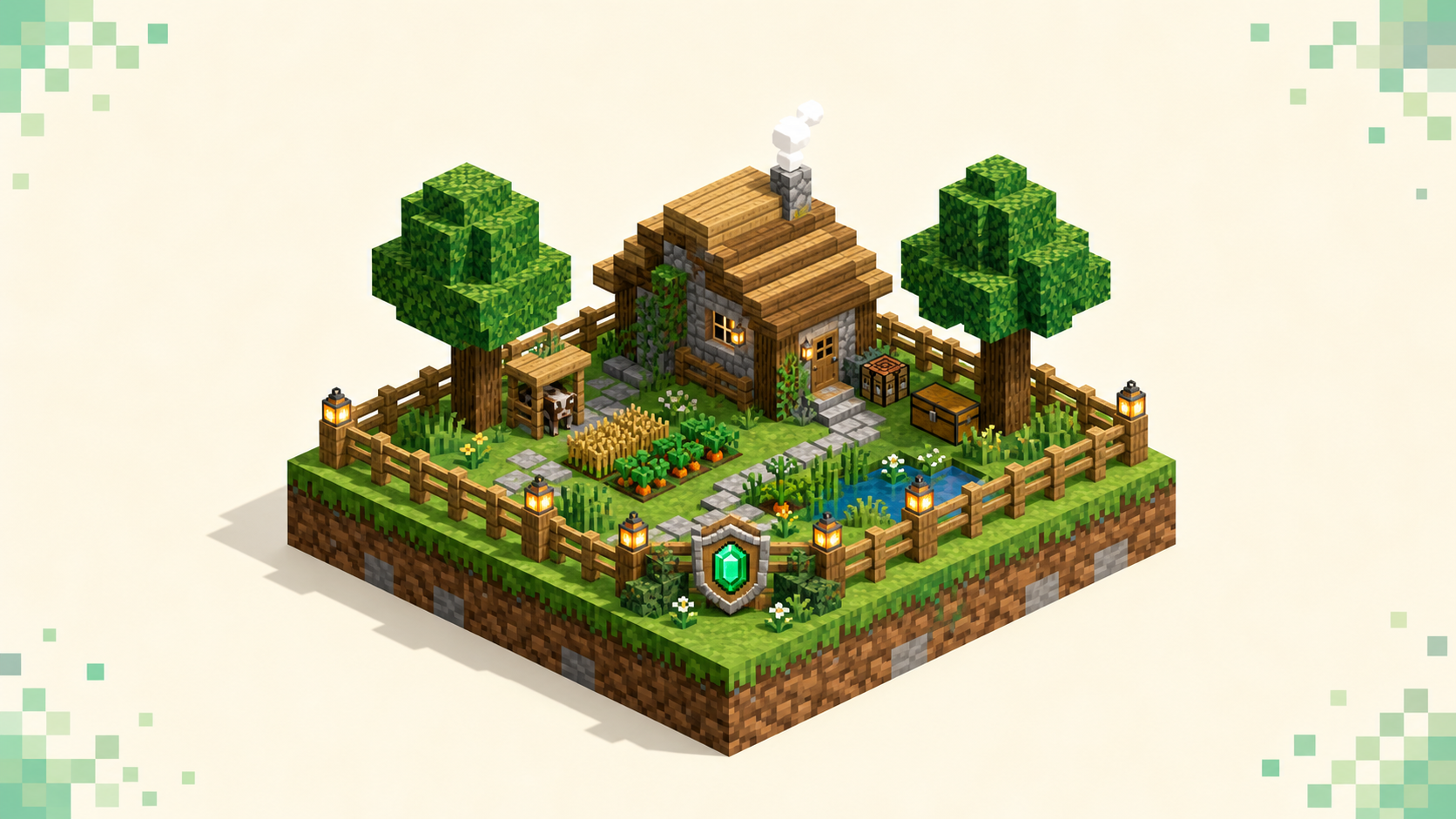
The first layer is land claims. Many survival servers let you mark out the area around your base so anyone you haven't trusted can't break or place blocks or get into your containers inside it. The common workflow looks the same once you've seen it: you get a claim tool, often a golden shovel, click two opposite corners of the area you want, and the outline and corner markers show up in-world so you can see what's protected. Your friends get added to the trust list and can build alongside you; everyone else is locked out. Not every server uses the same plugin, so the details vary, but the idea is consistent enough that you'll recognize it.
The second layer is admin-set protection. Staff can lock down regions like spawn or shared community areas so nobody edits them, regardless of claims. The third is block logging, and this is the one that saves you when something slips through. Good servers record every block placed or broken and every chest opened, so an admin can roll back the damage from a specific player over a chosen time window in seconds, without restoring the whole server. If you're not sure a server has it, the rules page usually says, or you can ask in their Discord.
For a small group, the realistic setup is claims plus an admin who can actually roll back damage. Nothing is ever one hundred percent, but those two together get you close enough that you can build without watching your back.
Why a whitelist or small population is the real fix
The single most reliable anti-grief measure isn't a plugin — it's fewer strangers. A whitelist means only approved accounts can join at all, so a griefer can't grief a server they can't connect to. For beginners, it works like this: the owner adds your username to an allow-list before you're able to log in, and if you try to join before that happens you'll get a "you are not white-listed" message. That's not an error on your end, it just means you haven't been added yet.
Even without a full whitelist, a low-population public server is usually calmer than a packed one. A few dozen regulars tends to mean tighter moderation and builds that actually stay standing, because the staff know who's around. A smaller server has quiet hours, and you won't always log in to a busy spawn. For a relaxed survival group that's the point, not a downside, but go in expecting it.
If what you really want is just your own friends and a persistent world, look specifically at SMP-style listings. SMP servers are built around lasting communities rather than the constant churn of competitive modes, which makes them a natural fit for a handful of people who plan to stick around. You can browse the SMP rankings the same way you would survival.
A checklist for picking a low-pop, claim-protected server
Run a candidate through this before you move anyone over.
- Protection is mentioned. The listing or rules should say something about land claims or protected regions. Check whether PvP is off or opt-in too, so PvP doesn't turn into people just killing you for your stuff if that's not what your group wants.
- There's someone to report to. An active staff team and a Discord where reports actually get answered are the strongest signs a griefer gets dealt with fast instead of never.
- The population fits. You want a steady small-to-mid community in the live player count and vote activity — not a ghost town, and not a two-thousand-player free-for-all where you're surrounded by strangers.
- Uptime looks healthy. Every listing here shows uptime, and a server that's frequently offline loses its regulars. For a base you're planning to keep, that's a real warning sign.
- Edition and version match your group. Confirm whether it's Java, Bedrock, or crossplay before you invite anyone, since Java and Bedrock don't talk to each other by default. Java's default port is 25565 and Bedrock's is 19132, which is a quick way to tell which one a listing is set up for.
- The host is near your group. Lower ping for everyone usually means picking a server in your region. You can filter by country to narrow the list down to servers close to wherever most of your friends are.
The monthly rankings do a lot of this filtering for you. Because the top of the survival list is ordered by this month's votes, it's a live read on what's active and worth your time, so start your shortlist there rather than from search results.
Red flags to avoid
- A near-zero player count for days. No community to play with, and usually a sign the admin is gone — which means if someone does grief you, nobody's coming to fix it.
- No rules, no staff, no Discord. With nobody to report a griefer to, claims become your only line of defense, and that's a thin one to rely on alone.
- No protection mentioned anywhere. A fully open survival world with no claims and open PvP is the highest-risk setup there is for a small group. Treat the absence of any protection talk as a no.
- A history of downtime in the uptime readout. Your builds aren't safe on a server that keeps vanishing for days at a time, however good it looks otherwise.
- An edition or version that splits the group. If half your friends are on Java and half on Bedrock, a single-edition server quietly leaves people out. Confirm everyone can actually connect before anyone gets attached to a base.
How to use the live rankings to find your server
The board is simple once you know the rule: servers are ordered by the votes they earn during the current calendar month, and the count resets when the month flips, so the list always reflects what's genuinely active rather than what was popular a long time ago. The full explainer on rankings goes deeper if you want it.
Start at the survival rankings for general survival worlds, or the SMP rankings if you want something community-first, and read each listing for claims, population, version, and uptime. Pull out two or three that look right, then hop in with one friend to test the moderation and check your ping before you move the whole group. Trying a few before settling in is completely normal, and it's a lot less painful than relocating an entire base because the server turned out to be dead at the hours you actually play.
If you need to narrow further, you can filter by version — those paths are dotted, like /servers/version/26.2 — or by country to match everyone's region. When in doubt, the full server list and the homepage rankings are the always-current source. Lean on those instead of any fixed list of names, including this one.
FAQ
What's the difference between a claim system and a whitelist for stopping griefing?
They solve different parts of the problem. A whitelist controls who can join at all — only approved usernames connect, which keeps strangers out entirely. Land claims control what a player who's already on the server can touch, protecting the blocks and chests inside your claimed area from anyone you haven't trusted. For a small friend group, a whitelisted survival server with claims gives you both layers: griefers can't get in, and even invited guests can't wreck a claimed base.
Can my friends and I play together if some are on Java and some on Bedrock?
Only on a server that specifically bridges both editions, usually labeled crossplay. Java and Bedrock aren't cross-compatible by default, so a Java-only address won't work for a Bedrock friend and the reverse is just as true. Before moving your whole group over, check each listing for which edition or editions it supports and confirm everyone can connect — Java uses port 25565 and Bedrock uses 19132 by default.
Is a claim-protected server completely griefer-proof?
No protection is absolute, but claims plus an active admin get very close. Land claims stop the everyday case of random players breaking blocks or looting chests in your area, and block logging lets staff roll back anything that slips past. The weak point is always trust: if you grant build access to someone inside your claim, they can edit it. Only trust people you actually know, and pick a server with responsive moderation so reports get handled quickly.
How can I tell a server's really active before I commit?
Look at vote count and live player count together, not just one. A high monthly vote total means a real community is logging in to vote for it, which is harder to fake than a player number that might be padded by bots or counted across a whole network. Then check the live count at the hours you'll actually play — a server can look busy at 8pm in its home region and sit empty when your group is on. If most of your friends are in another timezone, log in around your usual evening and see what spawn looks like before anyone builds.