Best Economy Servers for Trading and Player Shops
How to pick a Minecraft economy server with a living market — read population, shop plugins, earning loops, and anti-dupe before you trade.
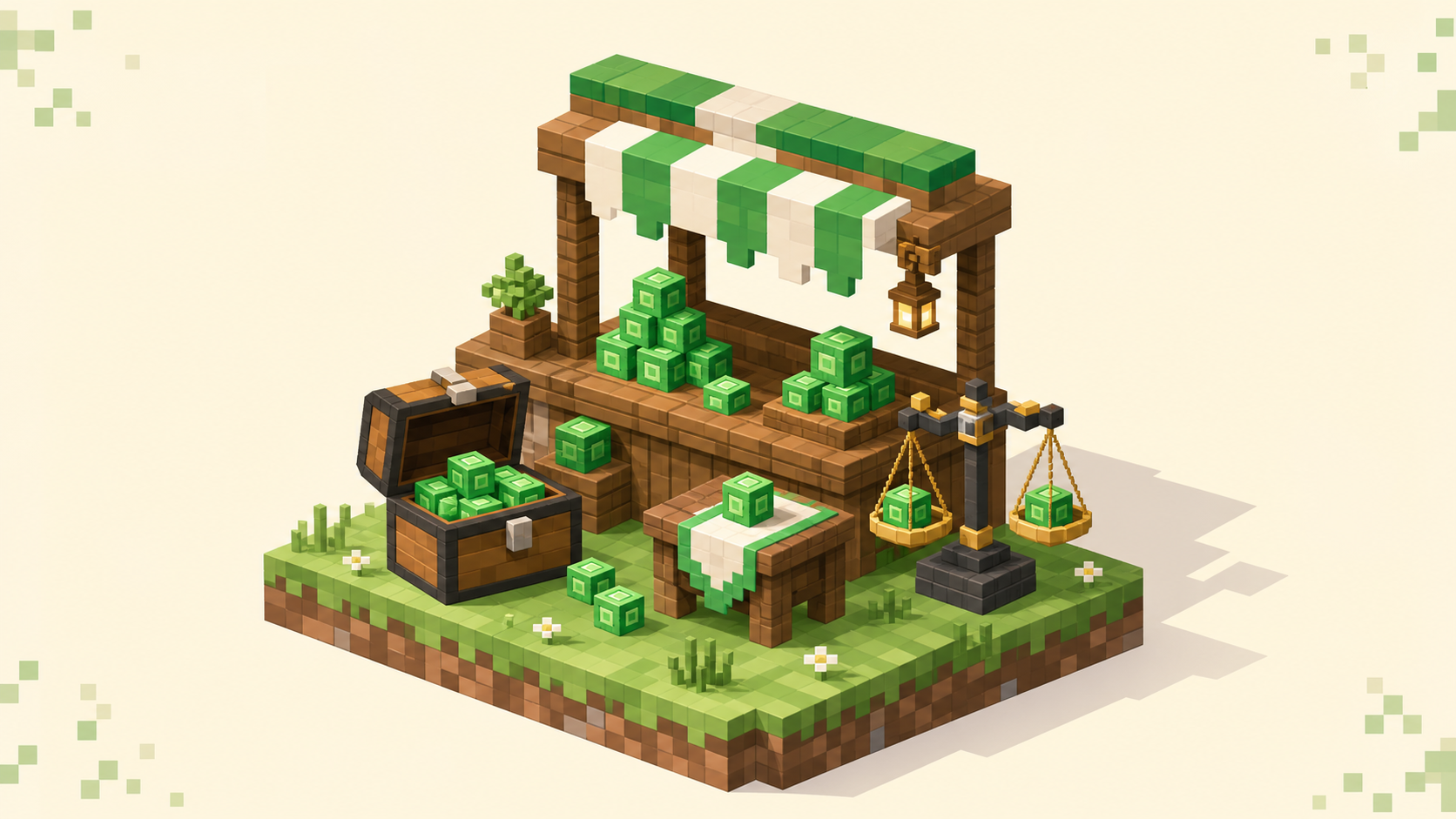
An economy server is only as good as the number of people trading on it, because the whole point is buying and selling with other players rather than a built-in shop. A deep currency system and a market district full of stalls mean nothing if there's nobody on the other end of the chest. So before you judge the feature list, judge whether the market is alive. I'm not going to name servers here, because the answer changes month to month — the live economy rankings already show which ones have players actually trading right now. What's worth your time is learning to read those listings for a healthy in-game economy versus a dead or broken one.
What an economy server actually is
Strip away the marketing and an economy server is a survival or SMP world built around a single shared in-game currency that you earn by playing and spend with other players. The "economy" isn't a cosmetic bolt-on — it's the loop of earning money, stocking a shop, and trading with everyone else on the server.
It helps to know the plumbing, because it tells you what to ask about. Underneath almost every economy server is a short stack of plugins working in order. Vault is the bridge — it's the API that lets every other plugin read and write balances, but it holds no money itself. Sitting on top is an economy plugin, commonly EssentialsX, which is the actual bank that stores each player's balance and gives you /balance and /pay. Everything else — the shops, the jobs, the auction house — talks to that bank through Vault. Without Vault and a Vault-compatible economy plugin, nothing can move currency at all.
That stack is why a player can't just bolt an economy onto someone else's server. The owner builds it, and your job as a player is to spot whether they built it well.
Player shops are the core signal
The single best tell that an economy is real is a server full of stocked, competitively priced player shops. These are chests that other players own, set a price on, and let you buy from or sell to automatically — 24/7, even while the owner is offline. When a market district is full of them and prices actually compete, money is moving.
There are two dominant models, and it's worth knowing which one a server runs.
- Sign-on-chest shops (ChestShop). The owner puts a chest down and a sign on it. The sign is four lines: a blank top line that auto-fills with their name, a quantity, a price line using
Bfor the buy price andSfor the sell price separated by a colon (something likeB 5:5 S), and the item on the bottom. You right-click the sign to buy and left-click to sell. It's the old, dependable option that's installed on a huge number of servers. - Click-the-chest shops (QuickShop-Hikari). No commands and no sign syntax — you hold the item, click a chest, and type a price. Each chest is buy-only or sell-only, and a double chest can run both at once. It also handles enchanted items, potions, tool damage, and mob eggs, which sign shops fumble.
Neither is strictly better; they just feel different to use. What matters for you is that the shops work while owners are offline and that there's a real market area where they cluster, rather than a spawn with three abandoned stalls.
Where new money comes from: jobs and the auction house
Every economy needs a faucet — somewhere fresh currency enters the world — or there's nothing to trade. The usual one is Jobs Reborn, which pays you in-game currency for ordinary actions: mining, farming, woodcutting, fishing, hunting mobs, building, enchanting, brewing. You open the menu and join with /jobs browse, and higher job levels pay more per action. When you're sizing up a server, "how does a brand-new player make their first bit of money" is the question Jobs answers, and a server without a clear earning loop leaves newcomers with nothing to spend.
Beyond local chest shops, most serious economy servers run an auction house — a server-wide market you reach with /ah. You list a held item with /ah sell <price>, browse everyone else's listings, and buy directly, usually with Buy-It-Now pricing and listings that expire. The auction house is where the rarer stuff trades, because a single chest shop only reaches whoever walks past it, while /ah reaches the whole server.
One detail worth understanding: a good auction house charges a small tax on sales. That tax isn't there to annoy you — it's a deliberate money sink, and sinks are what keep a currency worth anything.
The things that quietly kill an economy
Two problems separate a market that holds its value from one that's already ruined, and both are easy to miss when you first join.
The first is duplication glitches. Classic dupes abuse hopper, bundle, and piston timing or Nether-portal tricks to copy items, and on a currency server a single working dupe is catastrophic — it floods the market with goods and devalues everything anyone has traded for. A healthy server runs an anti-dupe layer that fingerprints items, flags duplicate UUIDs and illegal stacks, removes the copies, and alerts staff, backed by general anti-cheat. No plugin patches every dupe forever; new ones appear after each game update. The signal you're looking for is whether staff actively patch exploits and run anti-cheat, not a promise of zero dupes.
The second is inflation from faucets with no sinks. If jobs and grinder farms keep pouring new currency in but nothing ever drains it back out, prices climb until your money is worthless. The fixes are the boring-sounding ones — that auction-house tax, shop-creation fees, command costs — all draining currency back out of circulation. A server that talks up how much you can earn but never mentions where money goes is one to watch carefully.
Reading the live rankings
The economy rankings are ordered by votes earned during the current calendar month, and the tally resets when the month flips, so the top entries are the communities with players showing up right now — exactly what a trading economy needs. Voting is free and rate-limited per player, and any in-game vote rewards are a gameplay thank-you, nothing more.
Run the listings through a quick checklist. Look for a real, consistent player count rather than one fading spike, since buyers and sellers both need to be online. Check uptime, because a market you can't reach is a market you can't use. Then join the top two or three, head to spawn, and see for yourself: is there a market district full of stocked shops, does /ah have fresh listings, and can a new player find a clear way to earn? Ten minutes in-game tells you more than any feature list.
If the trade-driven, build-a-community feel appeals but you'd rather organize it around shared towns and a nation, Towny servers run a similar economy underneath town plots and taxes — the guide to building a nation on Towny walks through that side. Otherwise the full server list and the homepage rankings stay current the same way.
FAQ
What commands tell me an economy server is set up properly the moment I join?
Type /balance (or /bal or /money) to confirm there's a working economy plugin and see your starting balance. Run /baltop to see the richest players — a leaderboard with real spread means money is actually circulating, while everyone sitting at zero is a bad sign. Then /jobs browse to check there's an earning loop and /ah to see whether the auction house has live listings. If /ah is empty or /jobs doesn't exist, the economy is thinner than the spawn signs suggest.
How do I sell items, and what's the difference between /sell and a player shop?
On EssentialsX, /sell <item> <amount> sells to the server at a fixed price set in the server's worth.yml — instant, but usually a low rate, since it's a faucet the owner controls. A player shop is the open market: you stock a chest, set your own price, and other players buy from you, so you can charge more than the server pays but you have to wait for a buyer. New players lean on /sell for quick cash; the real money is in undercutting the market with your own shop.
Can I get out of paying the auction-house tax?
Not on /ah itself — the cut is skimmed off each sale automatically, and that currency leaves the game instead of going to anyone, which is the whole point of a sink. Depending on how the owner set things up, direct chest-shop sales often aren't taxed the same way, so big-ticket trades frequently get arranged player-to-player instead. Don't treat the tax as a reason to skip a server, though: a currency with no sinks anywhere inflates far faster than one that takes a few percent off /ah.
Does the server's version matter for joining an economy server?
It matters for connecting at all, not for the economy itself. Plugin economy servers may run 26.1, 26.2 or 26.3 depending on their core plugin compatibility. Your client and the server must share the same network protocol, so a 26.2 client trying a 26.1 server can throw an "Outdated server!" line. Match the version shown on each listing before you connect, and use the dotted version paths to filter — the hyphenated form like 26-2 just 404s.